Expertenanalyse zu Barnett Newmans Midnight Blue
Stil: Color Field Painting · Genre: abstract
Expert Analysis of "Midnight Blue" by Barnett Newman
Barnett Newman’s "Midnight Blue" is a quintessential work of Color Field Painting, a movement that emerged in the mid-20th century as a radical departure from the gestural intensity of Abstract Expressionism. Where earlier Abstract Expressionists like Pollock emphasized dynamic, all-over action, Newman and his peers shifted focus to vast, unmodulated expanses of color, aiming to evoke the sublime and the infinite.
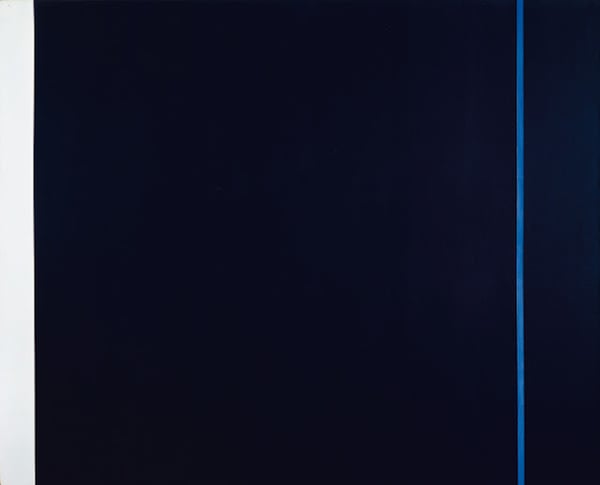
Newman’s signature formal device—the “zip”—is central to "Midnight Blue". Here, a single vertical band of a lighter or contrasting hue (often referred to as a zip) bisects a deep, nearly monolithic field of midnight blue. This is not merely a compositional element; it functions as a structural spine, creating a sense of tension and release. The zip forces the viewer to confront the relationship between the color field and the line, between vastness and interruption. Newman described his zips as “a declaration of space,” and in this work, the narrow band activates the entire canvas, preventing the blue from becoming a passive background.
The color itself—midnight blue—carries profound significance. Newman used color not as decoration but as a vehicle for emotional and spiritual resonance. This deep, enveloping hue suggests the nocturnal, the cosmic, the unknowable. It aligns with Newman’s stated ambition to create an art of the sublime—a concept borrowed from Romantic philosophy, denoting an overwhelming, awe-inspiring experience that transcends the rational. By reducing the painting to a single color field and a single zip, Newman eliminates narrative, figuration, and gesture, compelling the viewer into a direct, almost meditative encounter with the work’s material and optical presence.
Within the context of Color Field Painting, "Midnight Blue" exemplifies the movement’s core tenets: the primacy of color as subject, the rejection of illusionistic depth, and the embrace of monumental scale (typical of Newman’s work, the canvas is often large, enveloping the viewer). Newman’s influence was immense—he paved the way for later painters like Mark Rothko (who also sought the sublime through color) and Clyfford Still, but his approach remained distinctly architectural and austere.
The significance of "Midnight Blue" lies in its radical simplicity and its philosophical ambition. It asserts that a painting can be an experience, not just an object; that color alone, when handled with intelligence and intensity, can evoke the highest realms of human feeling. In the history of abstraction, Newman’s work represents a pivotal moment when the canvas became a field for pure perception, stripping art down to its essential elements and demanding that the viewer rise to meet it.
Museum / Gallery
Genre
Visuell ähnlich
20 Werke mit ähnlicher Komposition und Farbpalette
Black Fire I
Barnett Newman

Ligne rouge II n°19
Genevieve Asse
Painting #95032
Rudolf de Crignis
Number 17
John McLaughlin
The Third
Barnett Newman

Naxos
Jeremy Moon
Broadway
Ellsworth Kelly

The Dylan Painting
Brice Marden
No Mandatory Patriotism
Richard Serra

Sea Rise
Kenneth Noland
Untitled No. 5
Michael Heizer
"Cool" Series (Dark Pink over Brown)
Perle Fine
Exposed Painting Cadmium Red light
Callum Innes
Attrazione quadrata nel quadrato
Antonio Calderara
Sea Painting I
Brice Marden
Study for Stander
Brice Marden
Adam and Eve (#2)
Frederick Hammersley
Maintenant
James Bishop
Media (VII)
Jean Degottex
Exposed White Painting No.3
Callum Innes