Analisi esperta di Saint di Carlo Crivelli
Stile: Early Renaissance · Genere: religious painting
Analysis of "Saint" by Carlo Crivelli
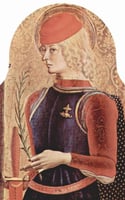
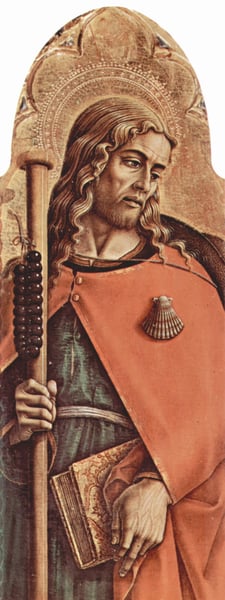
Carlo Crivelli stands as one of the most distinctive—and stubbornly anachronistic—figures of the Italian Early Renaissance. While contemporaries in Florence and Rome were embracing naturalism, linear perspective, and classicizing ideals, Crivelli, active mainly in the Marche and Veneto regions, sustained a highly ornamental, Late Gothic sensibility fused with a rigorous attention to surface detail. This painting, simply titled Saint, exemplifies that unique synthesis.
Significance within the Early Renaissance and Religious Painting
-
Ornate, Gold-Ground Aesthetic: Crivelli’s work is immediately recognizable for its lavish use of gold leaf, tooled halos, and gesso relief—techniques that recall medieval altarpieces. In this painting, the saint’s halo is likely embossed and burnished, creating a shimmering, three-dimensional effect that catches the light. This decorative richness was not mere archaism; it served a devotional purpose, elevating the sacred figure into a precious, heavenly icon, while simultaneously demonstrating the patron’s piety and wealth.
-
Meticulous Naturalism in the Service of Spirituality: Despite his Gothic trappings, Crivelli was deeply attentive to naturalistic detail—but of a particular kind. Textures are rendered with almost obsessive precision: the crisp folds of the saint’s velvet or brocade garment, the individual hairs of a beard or fur lining, and the realistic rendering of fruit, flowers, or attributes (such as a book, palm, or instrument of martyrdom). This hyper-detailed realism does not aim for the unified spatial illusion of Masaccio or Piero della Francesca; rather, it fragments the viewer’s focus, drawing the eye to each exquisite passage as an object of contemplative wonder.
-
Psychological Intensity: Crivelli’s saints are rarely serene. They are often depicted with sharp, angular features, furrowed brows, and an almost painful inwardness or ecstatic sorrow. The facial expression of this Saint—whether a martyr, bishop, or hermit—would convey a dramatic, emotional charge, typical of Crivelli’s ability to merge Gothic pathos with a new Renaissance interest in individual character. The saint’s gaze, perhaps directed outward or downward, creates an intimate, almost unsettling connection with the viewer.
-
Lingering Gothic in an Era of Change: Crivelli’s significance lies precisely in his resistance to the dominant Florentine narrative. In a period increasingly defined by rational space and classical harmony, his work preserves the symbolic, hieratic power of the medieval icon while infusing it with a new observational keenness. This painting is not an experimental trompe-l’œil study of a figure in space, but a multi-sensory devotional object: gold for divine light, precise detail for meditation, and emotional exaggeration for spiritual fervor.
Conclusion
This Saint by Carlo Crivelli is significant as a masterwork of the "International Gothic" within the Early Renaissance—a tradition that valued decorative splendor, tactile richness, and fervent emotion over the new mathematical naturalism. It reminds us that the Renaissance was not a single, linear progression, but a complex tapestry of regional schools, each with its own priorities. Here, Crivelli creates a sacred presence that is at once precious and poignant, archaic and startlingly immediate.
Visivamente simili
20 opere con composizione e palette affini
San Rocco
Ambrogio Bergognone
The Ghent Altar (detail)
Jan van Eyck
Saint Peter Martyr and Saint Venetianus of Camerino
Carlo Crivelli
Saints John the Evangelist and Lawrence
Defendente Ferrari
Saint Jerome
Carlo Crivelli
Polyptych of St. Peter (St. Ercolano)
Pietro Perugino
Saint Catherine of Alexandria
Carlo Crivelli
Solon
Justus van Gent
Apostles
Carlo Crivelli
John the Evangelist
Stefan Lochner
Saint Peter
Carlo Crivelli
Saint Bartholomew
Carlo Crivelli
Saint Paul
Carlo Crivelli
Saint Ursula
Carlo Crivelli
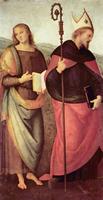
Altarpiece of St. Augustine - Scene John the Tufer and the St. Augustine
Pietro Perugino
Christ Crowned with Thorns
Sandro Botticelli
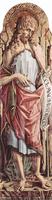
Saint John the Baptist
Carlo Crivelli
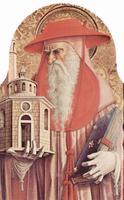
Saint Jerome
Carlo Crivelli
Mary Magdalene
Luca Signorelli
St Jerome and St John the Baptist
Masaccio