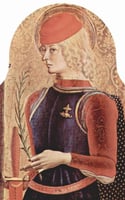
Analisi esperta di Saint George di Carlo Crivelli
Stile: Early Renaissance · Genere: religious painting
Expert Analysis of "Saint George" by Carlo Crivelli
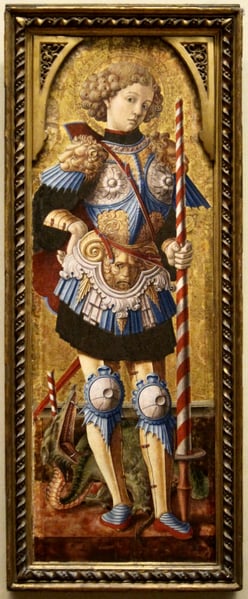
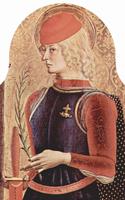
Carlo Crivelli’s Saint George is a striking example of the hybrid style that defines the artist’s unique position within the Early Renaissance. While his contemporaries in Florence were championing classical harmony and rational perspective, Crivelli—working primarily in the Marche and Veneto regions—preserved a distinctly late Gothic sensibility, infusing it with the meticulous observation and devotional intensity of the Renaissance religious painting genre.
Stylistic and Technical Significance
What makes this work significant is Crivelli’s masterful synthesis of decorative opulence and naturalistic detail. The painting features his hallmark gold ground, which creates a shimmering, otherworldly backdrop—a vestige of medieval iconography that elevates the saint from a historical figure to a timeless spiritual symbol. However, Crivelli does not rely solely on tradition. He renders Saint George’s armor with almost lapidary precision: each rivet, plate, and highlight is painted with the care of a goldsmith, reflecting contemporary Flemish influences in its lustrous realism. The dragon, twisted at the saint’s feet, is depicted with scaly, sinewy texture—a blend of Gothic grotesquerie and Renaissance observation of nature.
Composition and Iconography
Crivelli compresses the scene into a shallow, stage-like space, typical of his work. Saint George stands triumphant, his lance piercing the dragon’s mouth, while the princess (often included in the background) looks on with graceful, elongated proportions. The saint’s pose is both stately and dynamic: a contrapposto that hints at Renaissance anatomy, yet the elegant S-curve of his body retains the grace of International Gothic. The inclusion of a distant castle and idealized landscape—complete with rocky formations and a winding river—demonstrates Crivelli’s awareness of Renaissance perspective, though he applies it intuitively rather than mathematically.
Emotional and Devotional Impact
Crivelli’s religious paintings are renowned for their intense, almost tactile spirituality. In Saint George, the expression of the saint is serene but resolute, his gaze directed upward as if receiving divine sanction. The intricate detailing—from the gilded halos to the elaborate brocade of the princess’s gown—serves not merely as decoration but as a means of drawing the devout viewer into a contemplative state. Each element, however ornate, reinforces the moral victory of faith over evil.
Significance within Early Renaissance
Crivelli’s work challenges the linear narrative of Renaissance progress. While less “progressive” in perspective and naturalism than Masaccio or Mantegna, his Saint George exemplifies a parallel path—one that privileged symbolic richness, linear precision, and devotional intimacy. This painting stands as a testament to the enduring power of the Gothic tradition within the Renaissance, proving that spiritual expression could thrive alongside emerging humanist ideals. For art historians, Crivelli’s Saint George is a crucial bridge: a work that looks both backward to medieval splendor and forward to the detailed realism of the High Renaissance, all while remaining unmistakably personal and deeply moving.
Museum / Gallery
Visivamente simili
20 opere con composizione e palette affini
Archangel Michael
Carlo Crivelli
St. Michael
Fra Angelico
Saint Michael Triumphs over the Devil
Bartolome Bermejo
Saint Michael Triumphs over the Devil
Bartolome Bermejo
St. George
Andrea Mantegna
Saint Roch
Carlo Crivelli
Saint George
Yov Kondzelevych
Archangel Michael
Álvaro Pires de Évora
St. Michael and the Dragon
Antonio del Pollaiolo
Saint George
Pellegrino Tibaldi
The Archangel Michael
Francisco de Zurbaran
Saint George
Edward Burne-Jones

Saint Roch
Carlo Crivelli
Archangel Michael
Ivan Rutkovych
Saint George
Carlo Crivelli
St. Leopold
Lucas Cranach the Elder
St. George with head of the dragon
Lucas Cranach the Elder
Pala di Sant Agostino (Adoration of Pastors)
Pietro Perugino
Boy in Fancy Dress as a Roman Soldier
Nicolaes Maes
St. Michael slaying the dragon
Jean Fouquet