Bartolome Bermejo sanatçısının Saint Michael Triumphs over the Devil eseri hakkında uzman analizi
Tarz: Gothic · Tür: religious painting
Expert Analysis: "Saint Michael Triumphs over the Devil" by Bartolome Bermejo
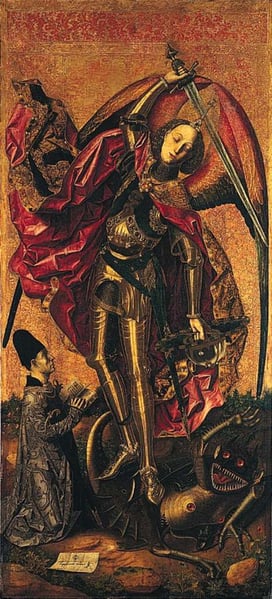
Bartolome Bermejo’s Saint Michael Triumphs over the Devil stands as a masterful example of the Hispano-Flemish Gothic style, a period when Spanish painting merged the luminous detail of Netherlandish art with the expressive intensity of Iberian religious tradition. The work’s significance lies in its sophisticated synthesis of Gothic formalism and emerging naturalism, rendered with a jewel-like precision that heightens the spiritual drama.
Stylistic and Technical Significance
As a Gothic religious painting, Bermejo employs the period’s characteristic gold leaf and intricate patterning—seen in Saint Michael’s richly ornamented armor and the heavenly background—to evoke a sense of divine transcendence. Yet he also introduces a remarkable volumetric solidity and anatomical naturalism, rare in earlier Gothic works. The saint’s muscular form and the contorted, grotesque devil demonstrate a shift from flat, symbolic representation toward a more convincing, tangible human presence. This blend of radiant, decorative surface and emerging realism marks Bermejo as a pivotal figure bridging medieval and Renaissance sensibilities in 15th-century Spain.
Narrative and Symbolic Power
The composition captures the climactic moment of victory: Archangel Michael, armored and winged, stands triumphant over a fallen, chained Satan. Bermejo heightens the moral contrast through color—Michael’s cool blues and shimmering gold versus the devil’s murky, twisted flesh—and through expressive detail, such as the saint’s calm, resolute gaze versus the enemy’s agonized grimace. The inclusion of armor and weaponry not only underscores the martial iconography of the archangel as warrior of God but also reflects the Gothic taste for chivalric imagery, translating spiritual combat into a visually compelling, earthly allegory.
Historical and Cultural Context
Bermejo worked in a period of religious fervor and artistic transition in Spain, where Gothic conventions still dominated but Flemish oil painting techniques (glazes, meticulous brushwork) were gaining influence. This work exemplifies that cross-pollination: the oil medium allows for subtle modeling and rich, translucent shadows that enhance the supernatural glow of the scene. The panel’s devotional function—likely an altar piece or private commission—is served by its immediate, dramatic clarity, making the theological lesson of good triumphing over evil accessible and emotionally resonant.
Significance within Gothic Art
What makes Saint Michael Triumphs over the Devil particularly significant is Bermejo’s ability to infuse the static, hierarchical tradition of Gothic religious painting with dynamic action and psychological depth. While retaining the iconic gold ground and flat spatial conventions of the style, he gives his figures a sculptural weight and narrative urgency that foreshadow the Renaissance. The work thus stands as a crucial document of the late Gothic period’s capacity for innovation—a testament to how Spanish artists absorbed and transformed Northern European influences to create a powerful, uniquely localized visual language for sacred subjects.
Museum / Gallery
Stil
Görsel olarak benzer
İlişkili kompozisyon ve renk paletine sahip 20 eser
Saint Michael Triumphs over the Devil
Bartolome Bermejo
Saint George
Yov Kondzelevych
St. Michael
Fra Angelico
St. George with head of the dragon
Lucas Cranach the Elder
Pala di Sant Agostino (Adoration of Pastors)
Pietro Perugino
St. George
Andrea Mantegna
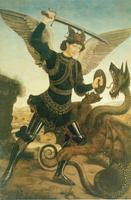
St. Michael and the Dragon
Antonio del Pollaiolo
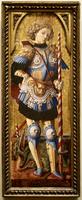
Saint George
Carlo Crivelli
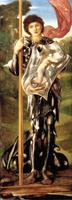
Saint George
Edward Burne-Jones
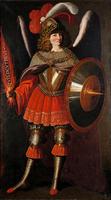
The Archangel Michael
Francisco de Zurbaran
St. Michael slaying the dragon
Jean Fouquet
The Last Judgement
Petrus Christus
Saint George and the Dragon
Rogier van der Weyden
St. Michael
Raphael
St. Leopold
Lucas Cranach the Elder
Saint Roch
Carlo Crivelli
Archangel Michael
Álvaro Pires de Évora
Archangel Michael
Ivan Rutkovych
Allegory of the Scuola di San Teodoro
Tintoretto
Portrait of a Knight
Vittore Carpaccio