Analisi esperta di Saint George di Yov Kondzelevych
Stile: Baroque · Genere: religious painting, icon
Expert Analysis: "Saint George" by Yov Kondzelevych
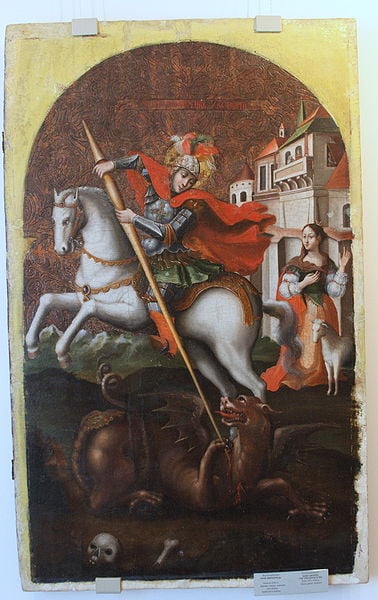
Yov Kondzelevych’s Saint George stands as a striking synthesis of two distinct artistic traditions: the dynamic, emotive energy of the Baroque and the hieratic, spiritual formality of the Eastern Orthodox icon. Painted in the late 17th or early 18th century, this work exemplifies the Ukrainian Baroque—a regional variant that emerged when Western European Baroque influences, introduced via the Counter-Reformation and Polish-Lithuanian Commonwealth, were absorbed into the centuries-old icon-painting practices of the Orthodox Church.
Significance within its Style and Period
-
Fusion of Baroque Drama and Iconographic Rigor
The Baroque period is known for its theatricality, dramatic contrasts of light and shadow (chiaroscuro), and a focus on movement and emotion. In Saint George, these qualities are evident in the swirling drapery of the saint’s cloak, the dynamic pose of the horse rearing against the dragon, and the intense, almost theatrical expression of triumph. Yet Kondzelevych retains the iconic gold background and the flattened, symbolic space typical of traditional icons. The saint’s frontal, solemn face and the use of tempera on wood anchor the work in its liturgical function, while the Baroque elements make the narrative more immediate and visceral. -
Crossover Between Elite and Folk Devotion
Kondzelevych worked primarily for churches and monasteries in the Carpathian region, where his icons served both as objects of veneration and as didactic tools. The Baroque influence here was not merely stylistic but also spiritual: by infusing the static icon with motion and emotional intensity, he made the saint’s victory over evil more accessible to a largely illiterate audience. This accessibility is a hallmark of the Ukrainian Baroque—a popular, grassroots adaptation of European trends that never fully abandoned the iconic tradition. -
Technical and Symbolic Innovation
Unlike pure Baroque religious paintings, which often emphasize illusionistic depth, Kondzelevych’s composition retains a hierarchical scale: Saint George is larger than the dragon, and his pose is both that of a soldier in combat and a saint in eternal repose. The gold leaf background, typical of icons, is not merely decorative but symbolizes the divine light of Heaven—a reminder that this is not a historical battle but a cosmic, timeless one. The Baroque elements (the stormy sky, the dramatic lighting effects) are thus subordinated to the icon’s theological purpose.
Conclusion
Saint George by Yov Kondzelevych is significant precisely because it refuses to choose between Western dynamism and Eastern tradition. It represents a moment of cultural and artistic negotiation on the borderlands of Europe, where Baroque theatricality was harnessed to serve Orthodox devotion. This work is not merely a derivative copy of Western models but a genuine, localized adaptation that enriches both the Baroque and the icon-painting traditions. It stands as a testament to the fluidity of artistic boundaries in the early modern period.
Genere
Stile
Visivamente simili
20 opere con composizione e palette affini
Saint George and the Dragon
Tintoretto
Saint George and the Dragon
Rogier van der Weyden
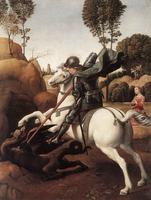
St. George and the Dragon
Raphael
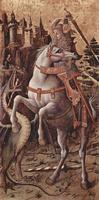
Saint George
Carlo Crivelli
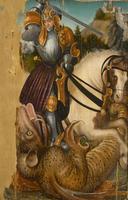
St. George with head of the dragon
Lucas Cranach the Elder
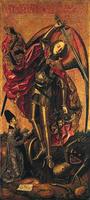
Saint Michael Triumphs over the Devil
Bartolome Bermejo
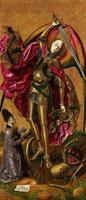
Saint Michael Triumphs over the Devil
Bartolome Bermejo
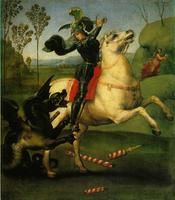
St. George and the Dragon
Raphael
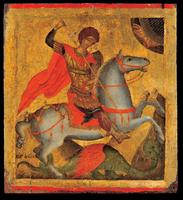
Saint George on Horseback Slaying the Dragon
Orthodox Icons
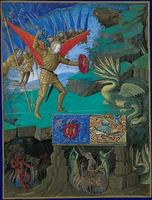
St. Michael slaying the dragon
Jean Fouquet
St George and the Dragon
Il Sodoma
Saint George and the dragon
Carlo Crivelli
Saint George with scenes from his life
Orthodox Icons
Saint George
Orthodox Icons
St. Michael
Fra Angelico
St. Michael
Raphael
St George
Tintoretto
Saint George
Carlo Crivelli
Captured statues and siege equipment, a representation of a captured City and inscriptions (Triumph of Caesar)
Andrea Mantegna
St. George and a Dragon
Peter Paul Rubens