
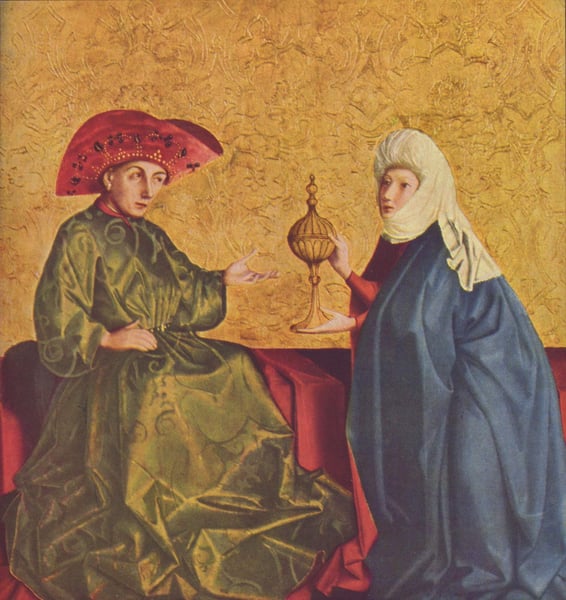
King Solomon and the Queen of Sheba
Ayrıntılar
Konrad Witz sanatçısının King Solomon and the Queen of Sheba eseri hakkında uzman analizi
Tarz: Northern Renaissance · Tür: religious painting
Expert Analysis of "King Solomon and the Queen of Sheba" by Konrad Witz
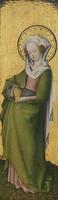
Konrad Witz’s King Solomon and the Queen of Sheba stands as a masterful exemplar of the Northern Renaissance, a period defined by its obsessive attention to naturalistic detail, symbolic richness, and the integration of sacred narrative with tangible, everyday reality. As a religious painting, the work does more than illustrate a biblical encounter—it anchors the moment in a meticulously observed, terrestrial world, thereby making the divine accessible yet awe-inspiring.
Significance within the Northern Renaissance:
-
Pioneering Naturalism and Spatial Construction:
Witz was among the first Northern artists to systematically apply atmospheric perspective and accurate light effects to create convincing depth. In this painting, the figures of Solomon and the Queen of Sheba are not flat, hieratic icons; they occupy a palpable, three-dimensional space, with shadows and highlights that model their robes and faces. The architectural setting—likely inspired by contemporary buildings or ruins—demonstrates Witz’s interest in rendering stone, wood, and textiles with near-sculptural precision, a hallmark of the Northern Renaissance’s break from Gothic stylization. -
Symbolism Woven into Realism:
Every object in the composition carries theological weight. The rich fabrics, jewels, and precious vessels exchanged by the queen allude to the Old Testament account (1 Kings 10) but also serve as visual metaphors for wisdom, wealth, and the recognition of divine truth. The detailed depiction of the queen’s lavish gifts—gold, spices, and gems—reflects the era’s fascination with material splendor as a mirror of spiritual glory, a common Northern Renaissance technique of encoding moral lessons within tangible beauty. -
Psychological Presence and Humanized Divinity:
Unlike earlier medieval renderings, Witz endows Solomon and the Queen of Sheba with distinct, individualized facial features and subtle gestures that convey a reciprocal exchange of intelligence and respect. The queen’s poised curiosity and Solomon’s majestic calm are rendered with a psychological depth that foreshadows portraiture. This humanization of biblical figures—making them look like contemporary rulers or merchants—was a radical shift that made scriptural stories relatable to 15th-century viewers. -
Role as a Religious Painting in a Changing World:
In an era when the Church was still the primary patron, Witz’s work exemplifies how Northern Renaissance artists balanced devotional function with artistic innovation. King Solomon and the Queen of Sheba likely served as an altarpiece or part of a larger ensemble, meant to inspire contemplation through its flawless craftsmanship. The painting’s fusion of sacred narrative with a believable, material world reflects the era’s broader theological trend: the belief that God’s presence could be discerned in the minute particulars of creation.
Conclusion:
Konrad Witz’s King Solomon and the Queen of Sheba is significant not merely as a biblical illustration but as a watershed in Northern Renaissance art. It marries exquisite technical skill—glimpsed in the shimmering fabrics, the soft fall of light, and the precise rendering of architecture—with a deeply humanistic interpretation of a seminal Old Testament story. The painting stands as a testament to the Northern Renaissance’s ambition: to reveal the sacred through the infinitely detailed, earthly real.
Museum / Gallery
Görsel olarak benzer
İlişkili kompozisyon ve renk paletine sahip 20 eser
Esther before Ahasuerus
Konrad Witz
St. Mary Salome and Zebedee with John the Evangelist and James the Great
Bernhard Strigel
Emperor Augustus and the Sybil of Tibur
Konrad Witz
Ecclesia
Konrad Witz
Saint Veronica Displaying the Sudarium
Robert Campin
The Announcement to Anne and Joachim
Bernhard Strigel
Abishai Kneeling before David
Konrad Witz
John the Evangelist
Stefan Lochner
Presentation of Cardinal de Mies to the Virgin
Konrad Witz
Saints Margaret and Apollonia
Rogier van der Weyden
Saint Mary Magdalene
Carlo Crivelli
Calvary Triptych (detail)
Justus van Gent
The Annunciation
Giovanni Bellini
Enthroned Madonna, Saint Jerome, and St. Sebastian
Carlo Crivelli
Saint Catherine of Alexandria
Carlo Crivelli
Madonna and Child with Donors
Palma Vecchio
Presentation of Christ in the Temple
Stefan Lochner
The Adoration of the Magi
Konrad Witz
Christ among the Doctors in the Temple
Jan Joest
Mary Magdalene
Stefan Lochner