
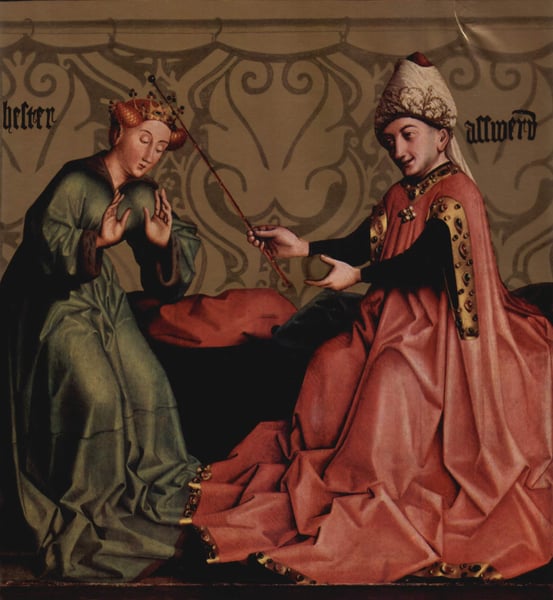
Esther before Ahasuerus
Dettagli
Analisi esperta di Esther before Ahasuerus di Konrad Witz
Stile: Northern Renaissance · Genere: religious painting
Expert Analysis of "Esther before Ahasuerus" by Konrad Witz
Konrad Witz’s Esther before Ahasuerus stands as a pivotal work within the Northern Renaissance, demonstrating a decisive shift from the decorative International Gothic style toward a more naturalistic and spatially coherent approach. Painted around 1440, this religious narrative scene captures the biblical moment from the Book of Esther—when Esther approaches King Ahasuerus to plead for her people—yet Witz transforms the familiar story into a showcase of innovative technique and symbolic layering.
Significance within the Northern Renaissance:
-
Pioneering Naturalism and Spatial Depth
Witz is celebrated for his early integration of convincing perspective and light. In this painting, the interior space is rendered with careful attention to architectural detail: receding floor tiles, sculpted columns, and a vaulted ceiling create a tangible, three-dimensional palace setting. This commitment to spatial logic, unusual for its time, anticipates the more systematic perspective of later Northern masters like Van Eyck. The falls of light and shadow across figures and objects add a sculptural solidity that grounds the sacred event in a believable earthly realm. -
Unflinching Portrayal of Human Emotion
Witz’s figures are not idealized but deeply human. Esther’s pose—hesitant yet resolute—conveys vulnerability and courage, while Ahasuerus’s extended scepter signals dramatic tension. The king’s startled expression and the attendants’ varied reactions imbue the scene with psychological realism. This emphasis on individual expression and narrative emotion is a hallmark of the Northern Renaissance’s shift toward humanism. -
Symbolic Integration of Sacred and Secular
Although a religious painting, the work is rooted in contemporary courtly life. The opulent costumes, gold brocades, and jewels reflect the Flemish-Burgundian court fashion of the 1440s. Witz deliberately merges the biblical past with the present to make the story more immediate for his audience. This layering of sacred meaning within a recognizable, material world is a defining characteristic of Northern Renaissance art. -
Technical Mastery in Detail
Witz’s precise handling of oil paint allowed for meticulous rendering of textures—the shimmer of silk, the hardness of marble, the softness of fur. Each object, from the glass vessel to the carved throne, is painted with an almost scientific observation. This microscopic attention to detail serves both aesthetic delight and symbolic function (e.g., the purity of glass alluding to Esther’s virtue).
Legacy:
Esther before Ahasuerus is significant not only for its artistic qualities but for how it exemplifies the Northern Renaissance’s departure from medieval flatness. Witz’s work influenced the development of landscape and interior painting in Switzerland and Germany, and his treatment of light would be expanded by later masters like Dürer. Here, the biblical story becomes a stage for exploring human drama, material reality, and the divine within the everyday—a dual focus that remains central to the era’s achievement.
Museum / Gallery
Visivamente simili
20 opere con composizione e palette affini
The Announcement to Anne and Joachim
Bernhard Strigel
King Solomon and the Queen of Sheba
Konrad Witz
St. Mary Salome and Zebedee with John the Evangelist and James the Great
Bernhard Strigel
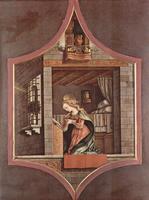
Virgin proclamation
Carlo Crivelli
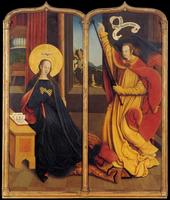
The Annunciation
Bernhard Strigel
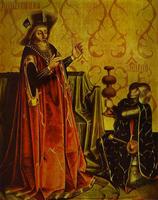
Abishai Kneeling before David
Konrad Witz
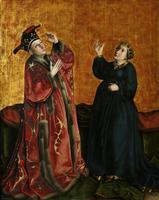
Emperor Augustus and the Sybil of Tibur
Konrad Witz
The Annunciation
Rogier van der Weyden
The Annunciation
Bernard Van Orley
St. Luke Drawing a Portrait of the Virgin Mary
Rogier van der Weyden
Saints Margaret and Apollonia
Rogier van der Weyden
Calvary Triptych (detail)
Justus van Gent
Annunciation
Lucas van Leyden
Saint Mary Magdalene
Carlo Crivelli
Annunciation
Filippo Lippi
The Adoration of the Magi
Konrad Witz
Presentation of Cardinal de Mies to the Virgin
Konrad Witz
The Annunciation
Robert Campin
Virgin Mary and John the Baptist, praying to the child Christ
Vittore Carpaccio
Saint Catherine of Alexandria
Carlo Crivelli