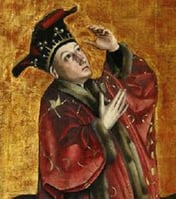
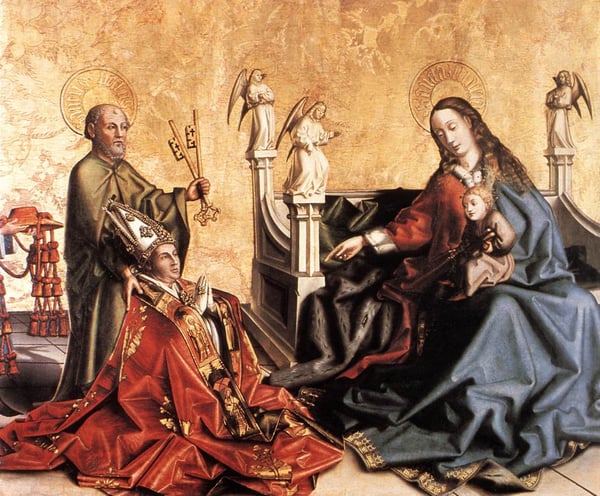
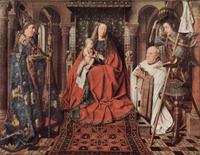
The Presentation of Cardinal de Mies to the Virgin by Konrad Witz is a landmark work of the Northern Renaissance, demonstrating the shift from late Gothic stylization toward a new naturalism grounded in observation. Painted in the early 15th century, the work is significant for its integration of a contemporary donor portrait—Cardinal de Mies—into a sacred scene, a convention that would become central to Northern Renaissance patronage. Witz achieves a remarkable balance between symbolic hierarchy and tactile realism: the Virgin and Child occupy a celestial realm, yet the cardinal kneels in a space that feels anchored in the physical world, his features individualized with the meticulous detail characteristic of the artist. The painting also reveals Witz’s pioneering interest in light and texture—seen in the reflective surfaces of textiles, the play of shadow across the cardinal’s face, and the atmospheric depth behind the figures. This fusion of earthly presence with divine subject matter, rendered with unprecedented specificity, underscores the era’s devotion to both spiritual truth and the tangible world, marking Witz as a crucial innovator in Northern Renaissance religious painting.