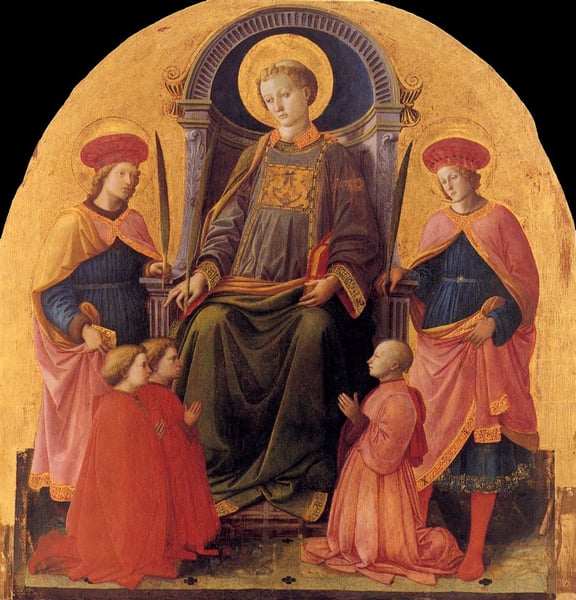
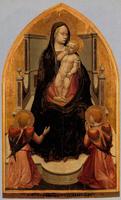
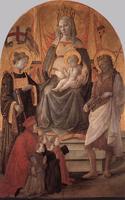
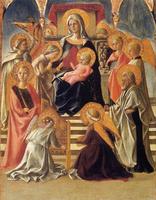
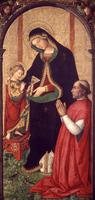
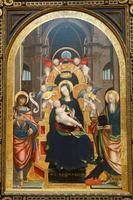
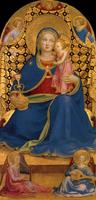
Filippo Lippi’s St. Lawrence Enthroned with Saints and Donors is a quintessential Early Renaissance religious painting that demonstrates the period’s shift toward naturalism, spatial clarity, and the integration of donor portraiture into sacred scenes.
The work’s significance lies in its balanced composition and humanistic treatment of figures. Lippi places St. Lawrence on a central throne—a traditional hierarchical device—but softens the formal arrangement by giving the saints and donors lifelike expressions and individual poses, reflecting the Early Renaissance interest in psychological realism. The donors, depicted in profile or three-quarter view, are not mere afterthoughts but active participants in the holy gathering, a growing convention that linked earthly devotion with divine presence.
Lippi’s handling of light and drapery further marks the piece as transitional: the sculptural folds of garments recall Masaccio’s volumetric forms, while the gentle, diffused light and delicate facial features anticipate the lyrical grace of later Florentine painting. The architectural throne, with its shallow niche and classical details, demonstrates the era’s renewed interest in perspective and antique motifs, framing the saint in a believable—yet reverent—space.
In the broader context of the Early Renaissance, this altarpiece exemplifies how artists like Lippi reconciled theological tradition with the emerging humanist desire for tangible, relatable sacred narratives—making it a key example of the period’s artistic and spiritual evolution.