
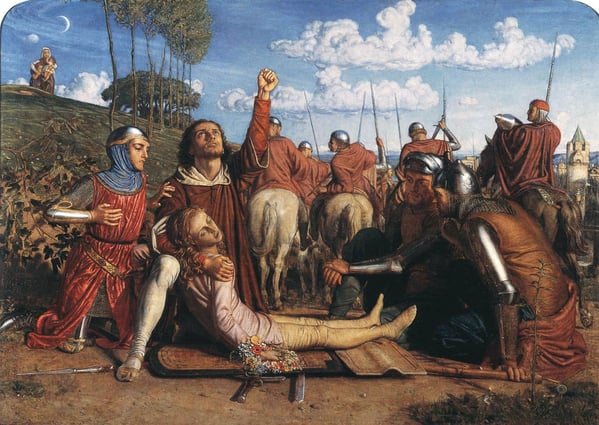
Rienzi Vowing to Obtain Justice for the Death of his Young Brother, Slain in a Skirmish between the Colonna and Orsini Factions
Details
Expertenanalyse zu William Holman Hunts Rienzi Vowing to Obtain Justice for the Death of his Young Brother, Slain in a Skirmish between the Colonna and Orsini Factions
Stil: Romanticism · Genre: illustration
Expert Art Historical Analysis
Artwork: "Rienzi Vowing to Obtain Justice for the Death of his Young Brother, Slain in a Skirmish between the Colonna and Orsini Factions"
Artist: William Holman Hunt
Style: Romanticism
Genre: Illustration
This work, executed in the Romantic style, exemplifies the period’s profound investment in historical narrative, heightened emotion, and the moral drama of individual conviction. Despite William Holman Hunt’s later fame as a founding member of the Pre-Raphaelite Brotherhood, this painting is firmly rooted in Romanticism’s fascination with medieval and Renaissance subjects, particularly those that pit a solitary hero against corrupt power.
The Subject and Its Romantic Significance
The painting depicts a pivotal moment in the life of Cola di Rienzo (often called Rienzi), the 14th-century Roman tribune who sought to restore the republic. Following the murder of his young brother in a clash between the feuding Colonna and Orsini noble families, Rienzi raises his hand to swear a vow of justice. The composition centers on this gesture, foregrounding the protagonist’s righteous anger and resolve. In Romantic terms, Rienzi embodies the archetype of the lone, passionate individual who defies a decadent establishment. The scene is not a dry historical record but a dramatized moral tableau, designed to evoke empathy and inspire the viewer with the nobility of a just cause.
Stylistic Characteristics of Romanticism
Hunt uses several hallmarks of Romantic painting:
- Expressive gesture and facial emotion: Rienzi’s raised arm and intense, upward gaze create a focal point of spiritual and political fervor. The faces of the surrounding figures—mourners, supporters, and the slain brother’s body—are rendered with individualized pathos, reinforcing the human cost of factional violence.
- Dramatic chiaroscuro and color: The lighting emphasizes the central figure while throwing the chaotic background into partial shadow, directing attention to the moral weight of the vow. Deep reds and somber earth tones heighten the gravity of the scene.
- Medievalizing detail: Architecture, costumes, and heraldic motifs are carefully described, reflecting Romanticism’s nostalgia for the Middle Ages as a time of strong principles and dramatic conflict—a contrast to the perceived corruption of modern society.
Significance as an Illustration
As an illustration, the painting operates as a visual narrative that condenses a complex historical event into a single, legible moment. It fulfills the Romantic goal of making history accessible and emotionally resonant. The title itself reads like a caption, guiding the viewer through the specific cause and consequence—an approach common in illustrated books and prints of the era. Hunt’s careful reconstruction of setting and costume also aligns with illustration’s documentary impulse, yet the emotional intensity elevates it beyond mere factual depiction into the realm of allegory.
Why This Work Matters
Within Romanticism, this painting is significant because it bridges history painting and illustration, two genres central to the Romantic project of educating and inspiring the public through art. It captures the era’s belief that the past could serve as a mirror for present-day struggles against injustice. Hunt’s early mastery of narrative composition—prefiguring his later Pre-Raphaelite precision—is already evident here. Ultimately, Rienzi Vowing to Obtain Justice stands as a powerful example of how Romantic artists used historical illustration to champion individual moral courage against the tyranny of factionalism, a theme that resonates across centuries.
Museum / Gallery
Visuell ähnlich
20 Werke mit ähnlicher Komposition und Farbpalette
The Crucifixion
Luca Signorelli
The Adoration of the Kings
Jacopo Bassano
The Death of Marmion
Edward Armitage
The Capture of Christ
Dirk Bouts
Saint Olav at the Battle of Stiklestad
Peter Nicolai Arbo
Chaucer at the Court of Edward III
Ford Madox Brown
Passion of Christ
Albrecht Altdorfer
Moses's Testament and Death (detail)
Luca Signorelli
Lamentation of Christ
Geertgen tot Sint Jans
The Knight of the Sun
Arthur Hughes
Lamentation over the Dead Christ with Angels and Saints
Luca Signorelli
Saint Peter Martyr
Giovanni Bellini
Calvary, central predella panel from the St. Zeno of Verona altarpiece
Andrea Mantegna
Raising of Lazarus
Jan Joest
The Adoration of the Magi
Raphael
Recover the body of St. Sebastian
Albrecht Altdorfer
Death of Baldwin I the Latin King of Jerusalem
Gustave Dore
Das Martyrium Des Hl. Sebastian (Sebastiansaltar)
Hans Holbein the Elder
The Martyrdom of St. Jacques
Andrea Mantegna
Entombment of Christ
Albrecht Altdorfer