Expert analysis of Andrea Mantegna’s Muse
Style: High Renaissance · Genre: mythological painting
Expert Analysis of Andrea Mantegna’s Muse
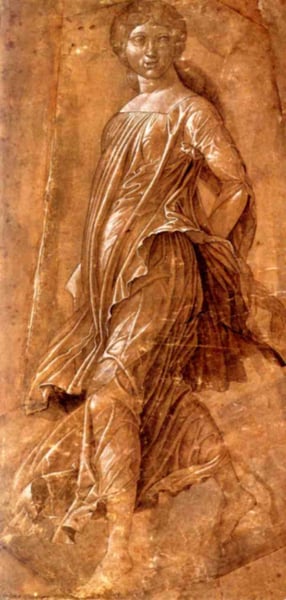
As a mythological painting from the High Renaissance, Andrea Mantegna’s Muse stands as a compelling example of the era’s fusion of classical antiquity with humanist idealism. While the full composition of this work is not detailed in the provided facts, Mantegna’s known oeuvre—characterized by rigorous perspective, sculptural solidity, and archaeological precision—allows us to infer its significance within the period.
Significance within High Renaissance Style
Mantegna was a master of trompe-l’oeil and linear perspective, techniques that lend his figures a startling physical presence. In Muse, the subject—one of the nine daughters of Zeus representing the arts—would be rendered with anatomical clarity and a sense of monumental gravity. This aligns with the High Renaissance emphasis on idealized naturalism, where the body becomes a vehicle for both divine beauty and intellectual symbolism.
Classical Revival and Humanist Ideal
The choice of a muse reflects the Renaissance reclamation of Greco-Roman mythology as a lens for exploring creativity and knowledge. Mantegna’s treatment likely draws on ancient statuary, giving the figure a marble-like stillness and proportion. This archaeological authenticity—seen in his famed Camera degli Sposi and Parnassus—makes Muse a vessel for humanist values: the pursuit of wisdom, harmony, and artistic transcendence.
Compositional Innovation
Mantegna frequently employed low viewpoints and dramatic foreshortening, as in his Dead Christ, to heighten emotional impact. If Muse employs similar spatial daring, the figure may seem to step outward into the viewer’s space, breaking the picture plane. Such innovation was radical for the period and underscores his role in advancing Renaissance pictorial space.
Legacy
While not as widely recognized as Mantegna’s Madonna della Vittoria or St. Sebastian, Muse encapsulates his contribution to High Renaissance art: a rigorous marriage of scientific perspective, classical erudition, and poetic grace. It stands as a testament to how mythological subjects were not mere decoration but vehicles for philosophical and artistic inquiry—a hallmark of the era’s greatest works.
Museum / Gallery
Visually similar
20 works with related composition and palette
Angel
Sandro Botticelli
Pallas
Sandro Botticelli
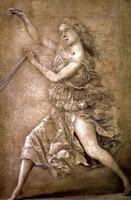
Muse
Andrea Mantegna
Allegory of Abundance
Sandro Botticelli
Figure study
Filippo Lippi
Female Figure
Filippo Lippi
The Dancing Girl
James McNeill Whistler
Diana
Correggio
Study for the ceiling of City Hall. Figure symbolizing the city of Madrid
Jean Auguste Dominique Ingres
Judith with the Head of Holofernes
Andrea Mantegna
Bacchante dancing with castanets
Giovanni Battista Piranesi
Apollon Dances with the Muses
Giulio Romano
Man with Sword
Donato Bramante
Study for the Age of Silver
Pietro da Cortona
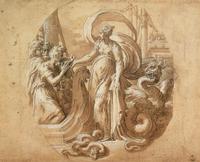
Circe and the Companions of Ulysses
Parmigianino
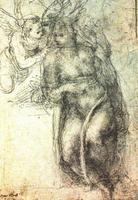
Annunciation (study)
Michelangelo
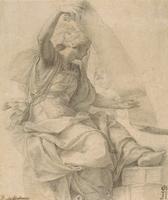
Sybil
Daniele da Volterra
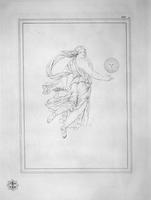
Bacchante leading ears; beside her the Sun
Giovanni Battista Piranesi
Madonna, Child and St.John the Baptist
Michelangelo
Bacchante with a sword
Giovanni Battista Piranesi