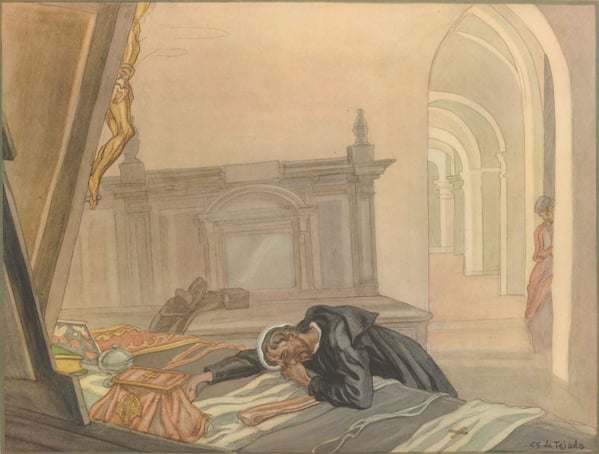
The Life of St. Ignatius Loyola. Plate 8. Before saying Mass, Ignatius is overcome with tears.
Details
Expert analysis of Carlos Saenz de Tejada’s The Life of St. Ignatius Loyola. Plate 8. Before saying Mass, Ignatius is overcome with tears.
Style: Art Nouveau (Modern) · Genre: history painting
Expert Art Historical Analysis
Carlos Saenz de Tejada’s The Life of St. Ignatius Loyola. Plate 8. Before saying Mass, Ignatius is overcome with tears. exemplifies a striking fusion of Art Nouveau’s decorative modernism with the solemn narrative conventions of history painting. Created as part of a series illustrating the life of the founder of the Jesuits, this work is significant for how it translates a moment of intense personal piety into the visual language of early 20th-century modernity.
Key Significance within Style and Period:
-
Art Nouveau’s Emotional Line
Instead of the rigid, academic naturalism typical of earlier religious history painting, Saenz de Tejada employs the sinuous, flowing contours characteristic of Art Nouveau. The saint’s bowed posture, the drapery of his vestments, and the surrounding architectural or spatial elements are rendered with a rhythmic, almost calligraphic line that conveys spiritual vulnerability and emotional surrender. Tears are not merely depicted but amplified through the undulating lines that seem to carry the viewer’s eye downward, mirroring Ignatius’s profound compunction. -
Modernist Sacred Intimacy
In the Modern era, large-scale religious history painting often became either monumental or sentimental. Here, Saenz de Tejada achieves an intimate, almost psychological depth—a hallmark of Modernist sensibility. The composition focuses closely on the saint’s face and hands, with the altar and crucifix present but softened by decorative patterns. This prioritization of inner experience over external spectacle aligns Art Nouveau’s interest in the subjective and the organic with the Counter-Reformation tradition of emotional engagement with faith. -
Decorative Harmony as Devotion
The work’s flat, stylized planes and subtle color harmonies—typical of Art Nouveau’s graphic design influence—elevate the scene from mere illustration to a meditative object. The border or framing elements (if present in the series) would likely echo plant-like forms, binding the sacred moment to nature’s cyclical beauty, a common Art Nouveau trope. This creates a unified visual field where the saint’s tears become part of a larger, harmonious spiritual universe. -
Renewal of Hagiographic Tradition
As Plate 8 in a life cycle, this work reimagines the centuries-old genre of saint’s lives for a modern audience. By infusing the scene with Art Nouveau’s organic grace—a style often associated with secular luxury and the Belle Époque—Saenz de Tejada demonstrates that religious feeling can be expressed through the same sophisticated, linear elegance found in the era’s posters, glassware, and interiors. The result is a history painting that feels both timeless and timely, bridging devotion and design.
Conclusion
This plate stands as a significant example of how Art Nouveau could serve not only decorative or Symbolist ends but also the deeply personal drama of religious history. Saenz de Tejada’s ability to render tears as both a literal emotion and a rhythmic, aesthetic motif makes the work a distinctive contribution to modern sacred art—one where faith is felt through line and form as much as through narrative.
Visually similar
20 works with related composition and palette
The Life of St. Ignatius Loyola. Plate 5. Ignatius and the first companions take vows at Montmatre 15th August 1534.
Carlos Saenz de Tejada
The Life of St. Ignatius Loyola. Plate 6. The vision at La Storta (outside Rome) I will be favourable to you in Rome.
Carlos Saenz de Tejada
Die Gartenlaube
Toby Edward Rosenthal
The Life of St. Ignatius Loyola. Plate 10. The Death of St. Ignatius 31st July 1556.
Carlos Saenz de Tejada
The Life of St. Ignatius Loyola. Plate 4. Ignatius and his friend, Francis Xavier, at the university of Paris. What does it profit a man if he gains the whole world but suffers the loss of his soul.
Carlos Saenz de Tejada
St. Gregory Dictating His Homilies to a Secretary
Charles-Andre van Loo (Carle van Loo)
A serious conversation
Ludwig Passini
Beguines at Prayer
Xavier Mellery
Marguerite in church listening to the Dies Irae
Achille Zo
King of Scots and Andrea Browne
Byam Shaw
Le pape et l'inquisiteur
Jean-Paul Laurens
The Connoisseur
Edward Von Grutzner
The Death of Guinevere
N.C. Wyeth
The Life of St. Ignatius Loyola. Plate 7. Pope Paul III approves the Society of Jesus 27th September 1540 Regimini Militantes.
Carlos Saenz de Tejada
Always poor
Frantisek Kupka
Vision of St. Augustine
Vittore Carpaccio
An afternoon of debate
Edward Von Grutzner
Hamlet and Ophelia
Dante Gabriel Rossetti
The Mass of Bolsena, from the Stanza dell'Eliodor (detail)
Raphael
St. Anthony Resurrects a Child
Piero della Francesca