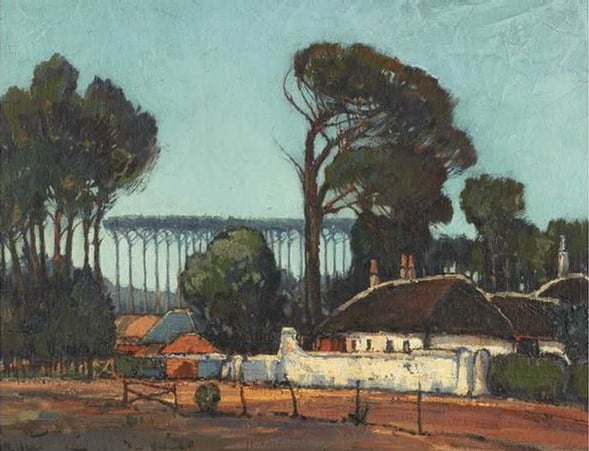
At Claremont, Cape Province
Pieter Wenning sanatçısının At Claremont, Cape Province eseri hakkında uzman analizi
Tarz: Impressionism · Tür: landscape
Expert Analysis of "At Claremont, Cape Province" by Pieter Wenning
Pieter Wenning (1873–1921) was a pivotal figure in bringing European Impressionism to South Africa, and At Claremont, Cape Province stands as a quintessential example of his adaptation of this style to the unique light and landscape of the Cape. The work is significant for several reasons within the context of Impressionism and South African art history.
1. Adaptation of Impressionist Principles to a Local Vernacular
True to the Impressionist genre, Wenning employs a broken-color technique and loose, visible brushstrokes to capture the transient effects of light and atmosphere. However, unlike the French Impressionists’ focus on urban Paris or the Normandy coast, Wenning turns his attention to the soft, hazy light of the Cape Province. The painting likely depicts the rolling hills, indigenous fynbos, and distant mountains characteristic of the region, rendered in a palette of muted greens, ochres, and cool blues—a tonal shift from the vibrant, sun-drenched hues often associated with European Impressionism. This demonstrates how Wenning synthesized the movement’s core ideals (capturing a “snapshot” of natural light) with a distinctly South African sense of place.
2. Role in Establishing a South African School of Landscape Painting
Wenning was instrumental in what is often called the “Cape Impressionist” movement. Arriving from the Netherlands in 1905, he brought firsthand knowledge of the Hague School and French Impressionism. At Claremont, Cape Province exemplifies his influence: the composition typically features a foreground of scrub or grasses, a middle ground of cultivated fields, and a backdrop of Table Mountain’s range or the Sand River valley. By choosing the suburb of Claremont—then a semi-rural area near Cape Town—Wenning elevates a modest, everyday view to a subject worthy of Impressionist treatment. This approach encouraged later South African artists to find beauty in their own landscape rather than relying on European models.
3. Technical Distinction: Luminosity and Atmosphere
The significance of this work within Impressionist painting lies in Wenning’s handling of en plein air light. He was particularly skilled at suggesting the limpid quality of Cape air—clear yet softened by coastal haze. In At Claremont, the viewer can imagine the subtle interplay of sun and cloud shadow across the undulating terrain. The brushwork is typically alla prima, with rapid, directional strokes that convey the texture of vegetation and the shifting light. This technique allows the painting to feel immediate and spontaneous, a hallmark of Impressionism that Wenning mastered.
Conclusion
At Claremont, Cape Province is not merely a derivative European Impressionist work; it is a foundational piece of South African modernism. Wenning uses the language of Impressionism to articulate the distinctive character of the Cape landscape—its gentle contours, its diffused light, and its quiet pastoral charm. The painting is significant as a bridge between international avant-garde methods and a burgeoning local artistic identity, cementing Wenning’s legacy as the father of South African Impressionism.
Görsel olarak benzer
İlişkili kompozisyon ve renk paletine sahip 20 eser
Dutch Landscape
Frederick Carl Frieseke
FIELD WORKERS
Nathaniel Hone the Younger
Les arbres au bord du chemin à Lagny
Léo Gausson
Old Cottage Plumstead
Pieter Wenning
A Village through the Trees
Camille Pissarro
Douglas Hall
Samuel Peploe
Landscape with Irises
Henry Ossawa Tanner
Village in the Provence
Paul Cezanne
Mimizan Plage, Landes
Winston Churchill
Woods at Mimizan
Winston Churchill
View of Farmlands
Jacobus Hendrik Pierneef
Under the Pine Trees at the End of the Day
Claude Monet
Pine and Aqueduct
Paul Cezanne
Trees near Breccles
Winston Churchill
The Cottage
Othon Friesz
Friendly Society's Gardens
David Davies
Trees
James Yates
Two cows in the meadow
Paul Gauguin
Landscape with trees and houses
Gregoire Boonzaier
Woodside Pastoral
Horace Trenerry