
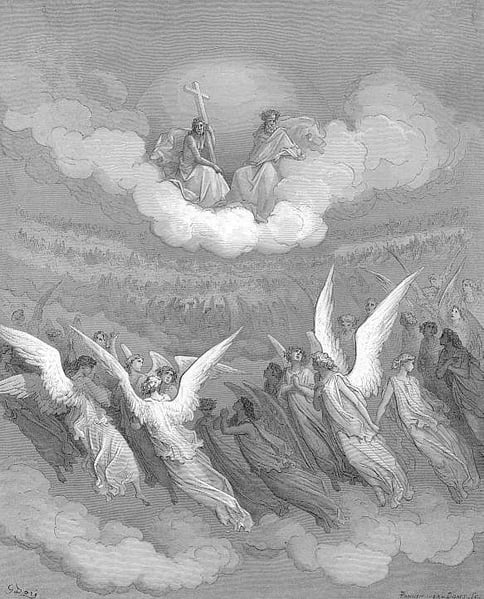
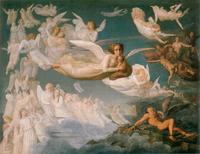
Heaven rung, With jubilee, and loud hosannas filled The eternal regions
Dettagli
Analisi esperta di Heaven rung, With jubilee, and loud hosannas filled The eternal regions di Gustave Dore
Stile: Romanticism · Genere: illustration
Expert Analysis: "Heaven rung, With jubilee, and loud hosannas filled The eternal regions" by Gustave Doré
This illustration by Gustave Doré, created for John Milton’s Paradise Lost, exemplifies the Romantic fascination with the sublime, the divine, and the epic. The work’s significance lies in how Doré translates Milton’s cosmic poetry into a visual language of grandeur, drama, and emotional intensity – hallmarks of the Romantic style.
Composition and Technique:
Doré employs a masterful interplay of light and shadow, known as chiaroscuro, to evoke the radiant, overwhelming presence of celestial glory. The composition is densely packed with figures—angels, cherubim, and the divine host—arranged in swirling, dynamic lines that pull the viewer’s eye upward. The heavens open in a burst of luminosity, while the foreground is cast in deep, dramatic darkness, creating a sense of awe and infinite scale. Doré’s technical precision in engraving allows for intricate details: the flutter of wings, the folds of robes, and the ecstatic faces of the worshiping multitude.
Romantic Significance:
As a Romantic illustration, this work prioritizes emotion over restraint, embracing the chaos and magnificence of the supernatural. The scene captures a moment of jubilant praise, but Doré does not shy away from the overwhelming, almost terrifying power of the divine. This aligns with Romanticism’s interest in the sublime—a beauty so vast and powerful that it borders on fear. The vertical thrust of the composition and the dramatic contrasts force the viewer to confront the infinite, a key Romantic impulse.
Place in Doré’s Oeuvre:
Doré’s illustrations for Paradise Lost (1866) are considered some of the finest literary interpretations of the 19th century. His ability to render Milton’s abstract celestial realms with such tangible drama made him the definitive visualizer of epic poetry. This specific plate, illustrating the heavenly jubilee from Book III, stands out for its sheer energy and orchestration of light. It is not merely an accompaniment to the text but an independent artistic statement that deepens the reader’s engagement with Milton’s theology.
Legacy:
Doré’s work bridged popular illustration and high art, influencing later fantasy and science fiction imagery. The swirling, luminous heavens and the densely packed angelic host prefigure the visual vocabulary of later epic fantasies. This illustration remains significant as a pinnacle of Romantic book illustration, where the printed page becomes a window into the sublime.
Visivamente simili
20 opere con composizione e palette affini
Paradise Lost
Gustave Dore
Purgatorio Canto 30
Gustave Dore
The Heaven of the Fixed Stars II
Gustave Dore
Beatrice
Gustave Dore
The Queen of Heaven
Gustave Dore
Beatrice II
Gustave Dore
St. Teresa with Child Jesus
Giovanni Battista Piranesi
The Cross
Gustave Dore
Les Neuf chœurs des Esprits célestes
Louis Licherie de Beurie
Cacciaguida
Gustave Dore
Scène Biblique (Moïse)
Fernand Combes
Angels, Guardian Angel
Palma il Giovane
Doomsday
Albrecht Durer
Saturn
Gustave Dore
Ecclesia Surrounded by Angels Holding the Instruments of the Passion
Bernardo Strozzi
Jacob's Dream
Raphael
The Transfiguration
Gustave Dore
Paradise Lost
Gustave Dore
The Celestial Pilot
Gustave Dore
Poème de l'âme 2: Le Passage des âmes
Louis Janmot