
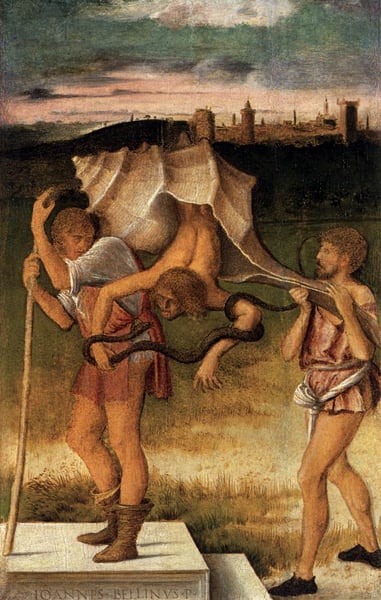
Four Allegories Falsehood (Wisdom)
Details
Expertenanalyse zu Giovanni Bellinis Four Allegories Falsehood (Wisdom)
Stil: Early Renaissance · Genre: allegorical painting
Expert Analysis of Giovanni Bellini’s Four Allegories: Falsehood (Wisdom)
Giovanni Bellini’s Four Allegories: Falsehood (Wisdom) is a pivotal work within the Early Renaissance, exemplifying the period’s shift from Gothic formalism to a more naturalistic, human-centered visual language. Executed as part of a series of small allegorical panels—often interpreted as moral or philosophical meditations—this painting demonstrates Bellini’s mastery of symbolic storytelling, luminous color, and atmospheric landscape integration.
Allegorical Structure and Humanist Significance The work belongs to the genre of allegorical painting, a mode that flourished in the Early Renaissance as artists and patrons sought to revive classical and humanist themes. In Falsehood (Wisdom), Bellini likely contrasts deceit with truth or wisdom—a common duality in Renaissance moral philosophy. The figural composition, while adhering to traditional emblematic clarity, is imbued with subtle psychological nuance: the personifications avoid stiff iconography in favor of gentle, descriptive poses that suggest inner states. This reflects the era’s interest in portraying virtues and vices as relatable, human experiences rather than abstract symbols.
Naturalism and Atmospheric Unity Bellini’s significance here lies in his revolutionary handling of light and landscape. The background—a serene, open vista with soft gradations of sky and distant hills—is not merely a backdrop but an active counterpart to the allegorical figures. The cool, silvery light unifies the scene, creating a palpable sense of atmosphere that softens contours and enhances the painting’s meditative tone. This integration of figure and nature was groundbreaking for the 1490s, setting the stage for the Venetian colorist tradition that Bellini would lead.
Transitional Style and Early Renaissance Innovation Painted during the height of the Early Renaissance, Four Allegories: Falsehood (Wisdom) bridges the late Gothic love of decorative detail with the Renaissance pursuit of perspective, proportion, and natural observation. Bellini employs a refined sfumato effect in the modeling of faces and drapery, while maintaining the crisp outlines characteristic of earlier panel painting. The result is a work that feels both timeless and intimately immediate—a hallmark of Bellini’s career and of the period’s broader artistic evolution.
Legacy As one of the earliest known independent allegorical series in Venetian painting, this work influenced later generations—including Giorgione and Titian—who would deepen the interaction between landscape, mood, and moral allegory. Today, Four Allegories: Falsehood (Wisdom) stands as a testament to Bellini’s ability to infuse humanist ideals with poetic restraint, anchoring the Early Renaissance’s fascination with wisdom and truth in a visually harmonious, enduring form.
Visuell ähnlich
20 Werke mit ähnlicher Komposition und Farbpalette

Law and Grace
Lucas Cranach the Elder
Barbara altar from the Kalanti church in Finland
Master Francke
Law and Grace
Lucas Cranach the Elder
Resurrection of Christ
Giovanni Bellini
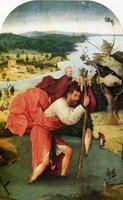
Saint Christopher
Hieronymus Bosch
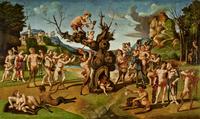
The Discovery of Honey by Bacchus
Piero di Cosimo
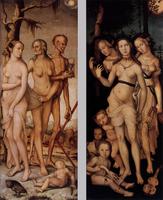
Three Ages of Man and Three Graces
Hans Baldung
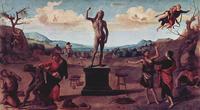
The Myth of Prometheus
Piero di Cosimo
The resurrection
Francesco Botticini

St. Jerome Praying
Hieronymus Bosch
The Marriage of Bacchus and Ariadne
Cima da Conegliano
Terrestrial Paradise
Hieronymus Bosch
Four naked
Pietro Perugino
The Martyrdom of St. Sebastian
Hans Memling
Apollo and Marsyas
Pietro Perugino
Saint Jerome Reading
Giovanni Bellini
Combat of Love and Chastity
Pietro Perugino
The Jabach Altarpiece
Albrecht Durer
The Silver Age
Lucas Cranach the Elder

Law and Gospel
Lucas Cranach the Elder