Expertenanalyse zu Sandro Botticellis Adoration of the Magi
Stil: Early Renaissance · Genre: religious painting
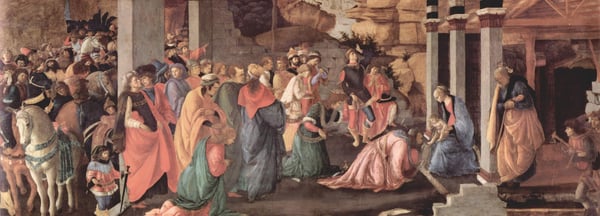
This painting by Sandro Botticelli, created around 1475–1476, is a landmark of the Early Renaissance, celebrated for its masterful fusion of religious narrative with contemporary Florentine politics and humanist ideals.
Significance within its style and period:
-
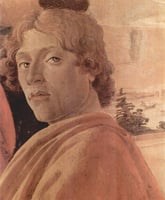
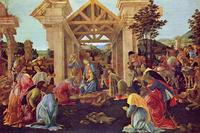
Medici Patronage and Self-Promotion: The work is best known for its inclusion of the Medici family—Florence’s de facto rulers—as the Magi and their retinue. Cosimo de’ Medici is traditionally identified as the kneeling Magus in the center, while his sons Piero and Giovanni appear nearby, and Botticelli himself is said to be the figure at the far right. This bold incorporation of living patrons into a sacred scene exemplifies the Early Renaissance practice of legitimizing political power through religious art, while also celebrating the Medici’s patronage of learning and the arts.
-
Narrative Clarity and Spatial Harmony: Botticelli organizes a crowded composition with remarkable clarity, using the crumbling classical architecture (a stable built from ancient ruins) as a framing device. The receding arches and textured stonework create a convincing three-dimensional space, while the gesturing figures and overlapping poses guide the viewer’s eye toward the Christ child. This balance of order and naturalism is a hallmark of the Early Renaissance’s move away from Gothic flatness.
-
Linear Grace and Expressive Detail: Botticelli’s signature sinuous lines animate the drapery, hair, and gestures—especially the elegant, flowing robes of the Magi. Unlike later High Renaissance chiaroscuro, his forms are defined by crisp outlines and decorative patterns, lending the scene a lyrical, almost tapestry-like quality. The rich, jewel-toned colors and detailed textures (gold trim, silks, armor) underscore the wealth and refinement of the donors, while the serene Madonna and Child provide a focal point of spiritual tenderness.
-
Humanist Synthesis: The painting reflects the era’s humanist interest in classical antiquity and individual portraiture. The Magi are not generic Eastern kings but recognizable Florentines, dressed in contemporary luxury garments. This merging of the sacred story with the here and now—typical of Botticelli’s mature work—makes the painting both a devotional object and a civic document, capturing the intersection of faith, family, and state during the height of Medici Florence.
Visuell ähnlich
20 Werke mit ähnlicher Komposition und Farbpalette
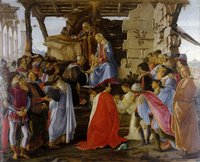
The Adoration of the Magi
Sandro Botticelli
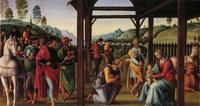
Altarpolyptychon, Predellatafel scene: Adoration of the Magi
Pietro Perugino
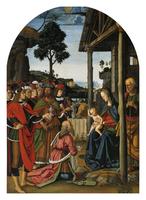
The Adoration of the Magi
Pietro Perugino
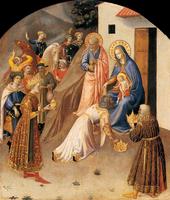
Adoration of the Magi
Fra Angelico
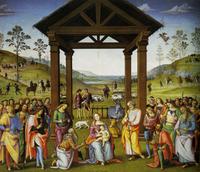
The Adoration of the Magi
Pietro Perugino
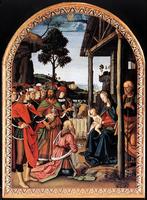
Adoration of the Kings (Epiphany)
Pietro Perugino
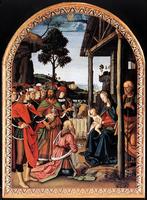
Moses's Journey into Egypt and the Circumcision of His Son Eliezer (detail)
Pietro Perugino
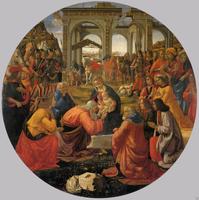
The Adoration of the Magi
Domenico Ghirlandaio
Adoration of the Knigs
Masaccio
Calvary Triptych (detail)
Justus van Gent
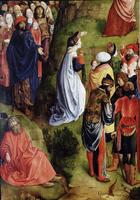
Calvary Triptych (detail)
Justus van Gent
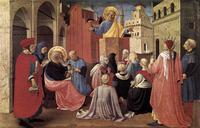
St. Peter Preaching in the Presence of St. Mark
Fra Angelico
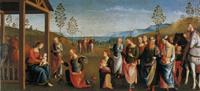
Pala di Sant Agostino (Adoration of the Magi)
Pietro Perugino
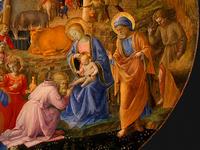
Adoration of the Magi (detail)
Filippo Lippi
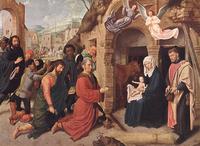
The Adoration of the Magi
Gerard David
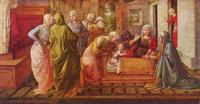
Ambrose Legend
Filippo Lippi
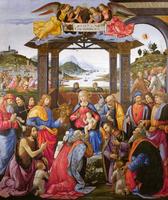
The Adoration of the Magi
Domenico Ghirlandaio
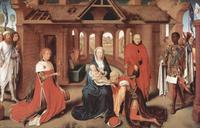
Adoration of the Magi, central panel of the Triptych of the Adoration of the Magi
Hans Memling
Polyptych Albani Torlonia (particular detail)
Pietro Perugino
Adoration of the Magi
Sandro Botticelli