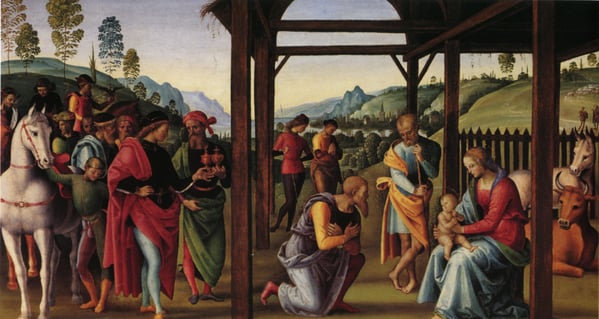
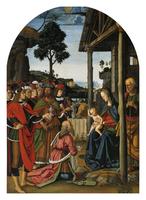
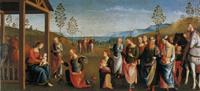
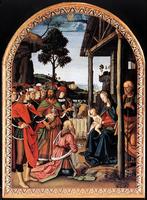
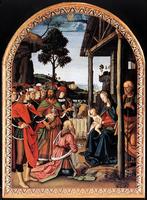
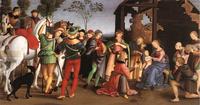
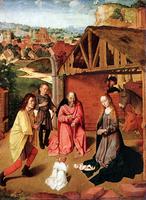
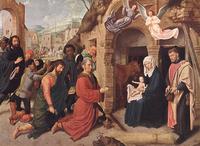
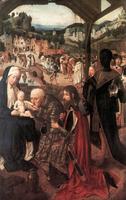
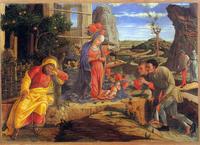
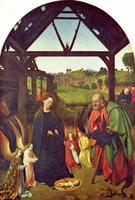
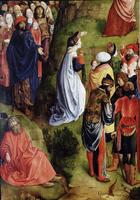
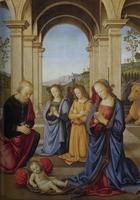
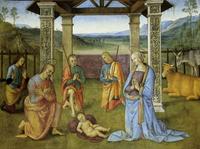
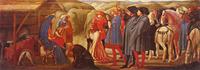
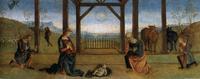
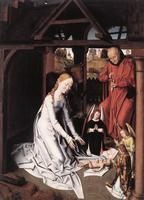
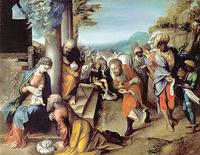
This artwork, the Predella Scene: Adoration of the Magi from Pietro Perugino’s Altarpolyptychon, is a quintessential example of High Renaissance religious painting. Its significance lies in how Perugino distilled the era’s ideals of clarity, harmony, and serene devotion into a compact narrative panel.
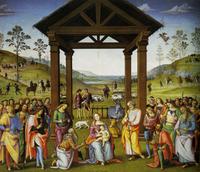
As a predella scene—the lower, narrative tier of a large altarpiece—the work demonstrates Perugino’s mastery of compositio, a central High Renaissance principle. He organizes the crowded moment of the Magi’s homage with perfect balance: the Holy Family is centered, flanked symmetrically by the three kings and their attendants, creating a calm, ritualized stillness even within the action. The use of one-point perspective, likely with a vanishing point near the Christ Child, draws the eye directly to the theological core of the scene.
Perugino’s signature soft, atmospheric landscape, with its gently sloping hills and hazy distances—borrowed from Flemish influence but refined into an Umbrian idyll—imbues the event with a timeless, pastoral grace. This fusion of precise spatial order and lyrical naturalism was hugely influential; Perugino taught Raphael, who would absorb this clarity and turn it toward even greater emotional depth. The Adoration of the Magi predella, though a secondary part of a polyptych, encapsulates the High Renaissance’s ambition: to make divine mystery feel rationally beautiful and peacefully present.