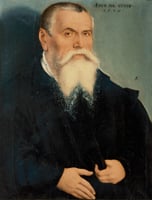
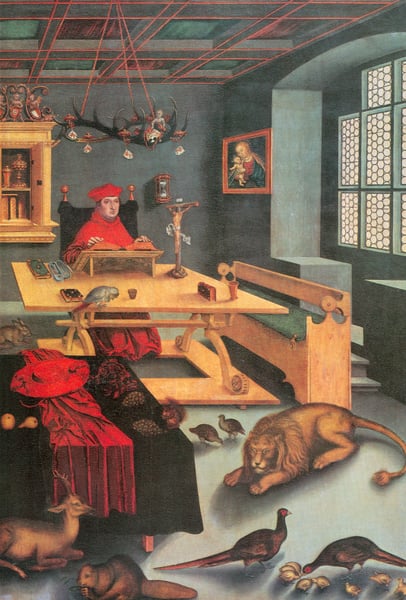
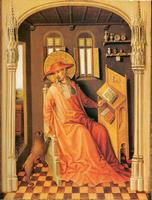
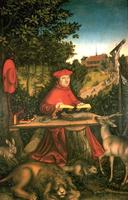
This artwork, Albrecht of Brandenburg as St. Jerome in his study by Lucas Cranach the Elder, is a prime example of Northern Renaissance portraiture that merges religious iconography with contemporary political and intellectual identity. The work transforms a standard devotional subject—St. Jerome in his study, the scholar-saint known for translating the Bible—into a powerful statement of humanist learning and ecclesiastical authority. By depicting the powerful Cardinal and Prince-Elector Albrecht of Brandenburg in the guise of St. Jerome, Cranach elevates the sitter’s status as a patron of the arts and a learned churchman, a common strategy in Northern Renaissance art to link living figures with revered saints.
Significantly, the portrait operates at the intersection of Reformation-era tensions. Albrecht was a major figure in the Catholic Church and a patron of artists like Cranach, who also worked for Martin Luther. The painting’s meticulous detail—characteristic of the Northern Renaissance—such as the intimate study setting, books, and scholarly props, emphasizes a humanist ideal of quiet contemplation and scholarship. This blending of a specific, recognizable portrait (Albrecht) with a traditional religious role (St. Jerome) exemplifies the period’s shift toward individual identity and personal piety, while also reinforcing the sitter’s spiritual and political authority through a timeless, saintly persona.