Expertenanalyse zu Bartolome Esteban Murillos Two Peasant Boys
Stil: Baroque · Genre: genre painting
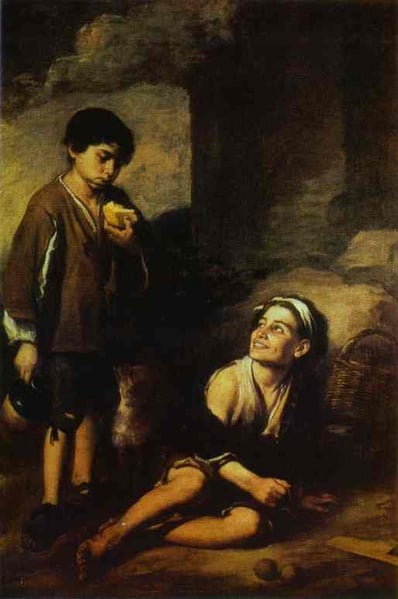
Expert Analysis: "Two Peasant Boys" by Bartolome Esteban Murillo
This work stands as a quintessential example of Murillo’s celebrated genre paintings, which elevated the everyday lives of the poor to a subject of profound artistic and emotional significance within the Spanish Baroque. Unlike the grandiose religious or mythological scenes typical of the era, Murillo turned his eye to the streets of Seville, capturing the humble reality of childhood with an unprecedented blend of naturalism and tender idealism.
Significance within the Baroque Style and Genre Painting
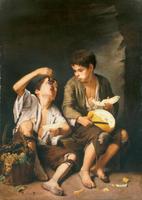
Murillo’s treatment of these two boys exemplifies the Baroque fascination with both verisimilitude and emotional engagement. The artist forgoes classical idealization; instead, he renders the boys’ ragged clothing, bare feet, and sun-bronzed skin with meticulous detail, grounding them in tangible reality. Yet their expressions—often of quiet contentment or playful mischief—imbue the scene with a sense of dignity and grace, avoiding the harsh moralizing that contemporary viewers might have expected from depictions of poverty.
This duality is key to Murillo’s significance. He humanizes the marginalized, elevating genre painting from mere anecdotal illustration to a vehicle for empathy. The soft, tenebristic light—a hallmark of Baroque drama—diffuses gently across the boys’ faces and tattered garments, creating a warm, intimate atmosphere. This lighting technique, inherited from Velázquez and refined by Murillo, directs our gaze not to a divine miracle or classical hero, but to the simple, fleeting humanity of two peasant children.
In the broader context of Baroque art, Two Peasant Boys demonstrates how genre painting could compete with history and religious painting in emotional power. Murillo’s influence helped popularize the “beggar boy” motif across Europe, inspiring later artists like Rembrandt (in his etchings of the poor) and the naturalist painters of the 19th century. The work remains significant today for its revolutionary empathy—a quiet but powerful assertion that the lives of the poor are not merely to be observed, but cherished.
Museum / Gallery
Visuell ähnlich
20 Werke mit ähnlicher Komposition und Farbpalette
Two Peasant Boys and a Negro Boy
Bartolome Esteban Murillo
Children Eating a Pie
Bartolome Esteban Murillo
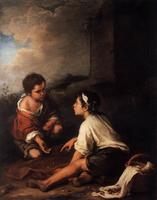
Two boys playing dice
Bartolome Esteban Murillo
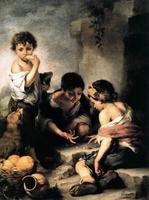
Boys Playing Dice
Bartolome Esteban Murillo
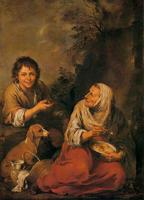
Peasant Woman and a Boy
Bartolome Esteban Murillo
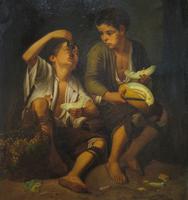
George Henry Hall after Bartolomé Esteban Murillo Boys Eating Grapes and Melon (copy)
George Henry Hall
L'aiuto Del Pastorello
Giuseppe Mazzolini
Smoker
Jan Steen
Small card players
Le Nain brothers
Saint Thomas of Villanueva dividing his clothes among beggar boys
Bartolome Esteban Murillo
Peasant Inn
Adriaen Brouwer
Two Boys Eating a Melon and Grapes
Bartolome Esteban Murillo
The Spinner
Pietro Longhi
The help of the little shepherd
Giuseppe Mazzolini
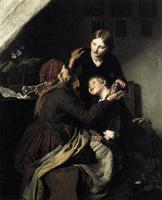
The Grandmother's Birthday
Ferdinand Georg Waldmüller
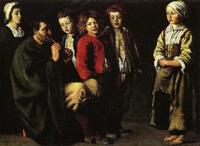
The old player of Flageolet
Le Nain brothers
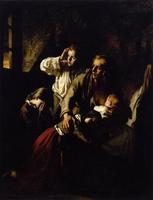
The Lightning
Alexandre Antigna
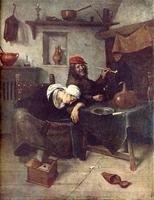
Idlers
Jan Steen
Joseph Telling his Dreams
Bernardo Strozzi
sansone e dalila
Domenico Fiasella