Expert analysis of Bartolome Esteban Murillo’s Two Boys Eating a Melon and Grapes
Style: Baroque · Genre: genre painting
Expert Art Historical Analysis: "Two Boys Eating a Melon and Grapes" by Bartolomé Esteban Murillo
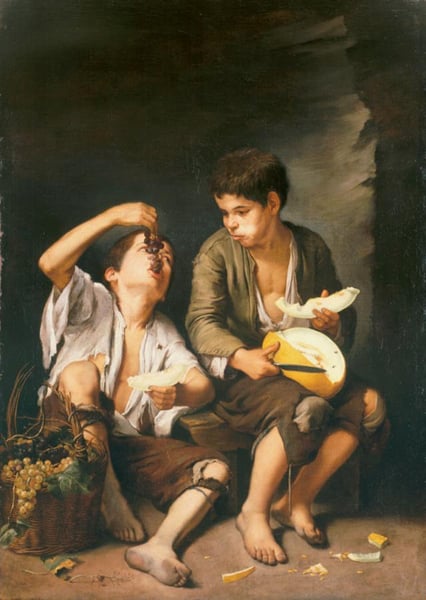
Bartolomé Esteban Murillo’s Two Boys Eating a Melon and Grapes (c. 1655–1660) is a quintessential example of Baroque genre painting that elevates the humble, everyday life of Seville’s street children into a scene of profound emotional resonance. This work is significant for several reasons within the Baroque period and Murillo’s own oeuvre.
Realism Softened by Idealism
While the painting is firmly rooted in the Baroque fascination with naturalism – evident in the textures of the melon’s rind, the translucent grapes, and the boys’ tattered clothing – Murillo infuses the scene with a gentle, almost sentimental idealism. Unlike the harsh, moralizing depictions of poverty common in Northern Baroque works, Murillo’s children are not pitiable; they are joyful, innocent, and absorbed in the simple pleasure of shared food. The older boy’s protective gaze and the younger one’s eager bite convey a bond of affection that transcends their material deprivation. This blend of gritty realism and warm humanity became a hallmark of Murillo’s style and set his genre scenes apart from contemporaries like Velázquez.
Chiaroscuro and the Divine in the Mundane
The dramatic lighting – a key Baroque device – falls directly on the boys’ faces and the melon, while the background dissolves into deep shadow. This chiaroscuro not only heightens the three-dimensionality of the forms but also echoes the religious paintings for which Murillo was famous. By applying such sacred compositional techniques to a secular, low-life subject, Murillo implicitly dignifies the act of eating as a moment of grace. The melon and grapes themselves carry faint symbolic overtones: fruit often alluded to the Fall of Man or earthly temptation in Baroque art, yet here they represent natural abundance and childlike gratitude – a kind of secular eucharist.
Innovation in Genre Painting
Murillo was among the first Spanish painters to treat scenes of poor children with this degree of tenderness and visual importance. Before him, such subjects were typically included as marginal figures in larger compositions or as comedic types. In Two Boys Eating a Melon and Grapes, the boys are the sole protagonists, their expressions and gestures carrying the entire narrative. This focus on childhood as a distinct emotional state – rather than a mini-adult stereotype – was pioneering and would influence later Spanish and European genre painters.
Legacy and Significance
The painting exemplifies Murillo’s ability to synthesize influences: the earthy tenebrism of Velázquez, the Flemish still-life precision of Rubens’ circle, and the Counter-Reformation emphasis on direct, heartfelt emotion. Its enduring appeal lies in its universal theme of sharing and joy in meager circumstances, making it a masterwork of Baroque humanism. Today, it stands as a key document of 17th-century Spanish social history and a testament to Murillo’s unique voice – one that found the sublime in the simple act of two boys eating fruit.
Museum / Gallery
Visually similar
20 works with related composition and palette
George Henry Hall after Bartolomé Esteban Murillo Boys Eating Grapes and Melon (copy)
George Henry Hall
Children Eating a Pie
Bartolome Esteban Murillo
Child with rabbits
Polychronis Lembesis
Boys Playing Dice
Bartolome Esteban Murillo
The Little Fruit-Seller
Bartolome Esteban Murillo
The Young Beggar
Bartolome Esteban Murillo
Two Peasant Boys and a Negro Boy
Bartolome Esteban Murillo
Two Peasant Boys
Bartolome Esteban Murillo
Two boys playing dice
Bartolome Esteban Murillo
The hunters and the farmers
Pietro Longhi
Joseph Telling his Dreams
Bernardo Strozzi
La Becquee
Elizabeth Jane Gardner
Peasant Woman and a Boy
Bartolome Esteban Murillo
The fisherman's family
Giovanni Battista Torriglia
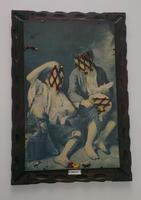
Murillo #1
Lorenzo Belenguer
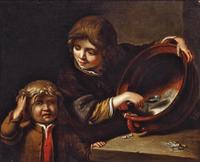
Zwei Kinder Bei Der Mahlzeit
Jan Miense Molenaer
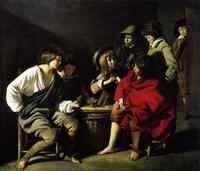
Small card players
Le Nain brothers
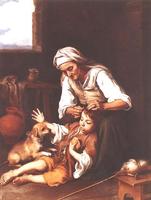
The Toilette
Bartolome Esteban Murillo
Wirtshausszene
Barbara Krafft
Country interior
Le Nain brothers