Analisi esperta di The Madonna and Child with st.Anna. di Masaccio
Stile: Early Renaissance · Genere: religious painting
Expert Analysis of The Madonna and Child with St. Anne (c. 1424–1425) by Masaccio
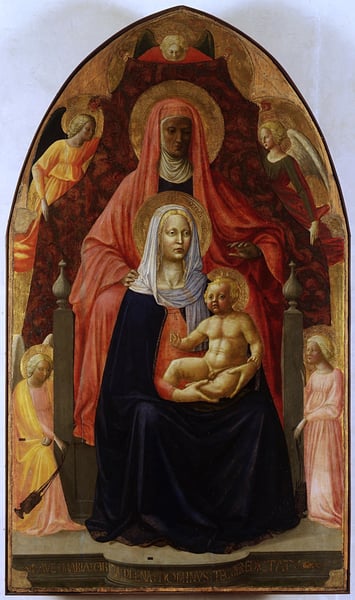
Masaccio’s The Madonna and Child with St. Anne—also known as the Sant’Anna Metterza—stands as a pivotal early Renaissance altarpiece that redefined religious painting through its radical naturalism and spatial clarity. Painted in tempera on panel, this work marks a decisive break from the decorative, gold-leafed conventions of the International Gothic style that still dominated Tuscan art in the early 1420s.
Profound Spatial and Humanist Innovations
The painting depicts St. Anne seated behind the Virgin Mary, who holds the Christ Child—a traditional Anna metterza composition. Yet Masaccio transforms this hierarchical, medieval formula into a scene of palpable human presence. The figures are solidly modeled with chiaroscuro (strong contrasts of light and shadow), giving them a sculptural weight unprecedented in Florentine painting. The Child, far from a miniature adult, is a believable infant, and the Virgin’s hand gently pressing his knee introduces a tender, psychologically resonant gesture.
Landmarks of Early Renaissance Style
- Perspective and Architecture: Masaccio employs a rational, one-point perspective in the throne’s architecture and the flanking angel’s posture. The solid, volumetric forms of the throne and the foreshortened angels demonstrate a systematic understanding of linear perspective—a technique Masaccio helped pioneer alongside Brunelleschi.
- Light as Unifying Force: The light source is consistent and natural, falling from the left to carve out the drapery folds and the Virgin’s serene face. This unified illumination replaces the flat, symbolic gold background, rooting the holy figures in a credible earthly realm.
- Naturalism and Gravity: The figures’ heavy, layered garments and the Child’s realistic anatomy reflect a study of antique sculpture and direct observation. The Virgin’s lap is convincingly capable of supporting the Child’s weight—a subtle but revolutionary detail.
Significance within the Early Renaissance
This altarpiece, originally painted for the Church of Sant’Ambrogio in Florence, reveals Masaccio’s ambition to fuse late Gothic elegance with a new, human-centered realism. It directly influenced contemporaries like Fra Angelico and later masters such as Michelangelo. Most critically, the work demonstrates how Masaccio used line, light, and space to create a sacred narrative that feels immediate and tangible—a hallmark of the Florentine Renaissance that would transform Western art. The painting’s survival is a testament to its enduring power: it remains a foundational study in how art can elevate theological subject matter through the convincing illusion of life.
Museum / Gallery
Visivamente simili
20 opere con composizione e palette affini
Perugia Altarpiece (central panel)
Fra Angelico
San Giovenale Triptych. Central panel
Masaccio
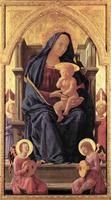
Maria and Child
Masaccio
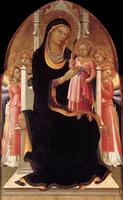
Virgin and Child with Six Angels
Lorenzo Monaco
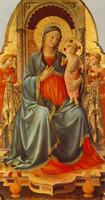
Madonna with the Child and Angels
Fra Angelico
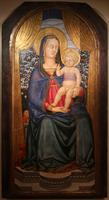
Madonna in trono col bambino
Lo Scheggia
Madonna and Child of the Grapes
Fra Angelico
St. Juvenal Triptych
Masaccio
Madonna and Child
Filippo Lippi
Madonna and Child Enthroned with Saints
Filippo Lippi
Madonna and Child
Filippo Lippi
Madonna Col Bambino
Álvaro Pires de Évora
Virgem Do Leite Entre São Pedro E São Francisco
Álvaro Pires de Évora
The Holy Family with Angels
Defendente Ferrari
Madonna and Child Enthroned Among St. Benedict, St. Scholastica, St. Ursula and St. John Gualberto
Benozzo Gozzoli
Madonna and Child with Angels
Il Sassetta (Stefano di Giovanni)
Virgin and Child with Sts. Dominic and Catherine of Alexandria
Fra Angelico
Madonna Del Latte
Antoniazzo Romano
Virgen Con El Niño
Álvaro Pires de Évora
The Virgin and Child surrounded by Five Angels
Sandro Botticelli