
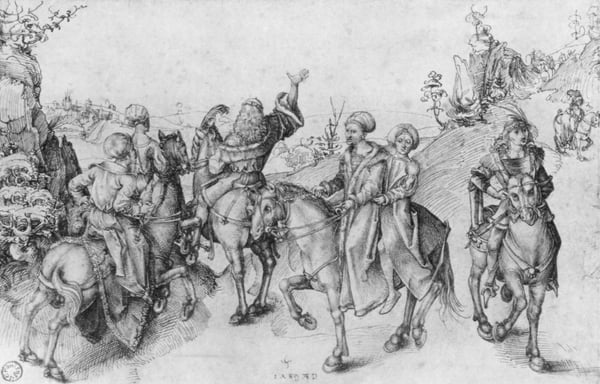
Expertenanalyse zu Albrecht Durers Society on horseback
Stil: Northern Renaissance · Genre: genre painting
Expert Analysis: "Society on Horseback" by Albrecht Dürer
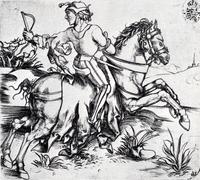
Albrecht Dürer’s "Society on Horseback" stands as a quintessential example of Northern Renaissance genre painting, where meticulous naturalism converges with a keen observation of contemporary life. While Dürer is celebrated for his groundbreaking prints and religious altarpieces, this work showcases his ability to elevate a secular, everyday subject—here, a group of riders—into a study of human activity within a specific social and environmental context.
Significance within the Northern Renaissance Style
The Northern Renaissance is distinguished by its intense focus on detail, texture, and the tangible world. In this painting, Dürer applies that same precision to a genre scene, rendering each horse’s musculature, the sheen of polished leather tack, and the subtle folds of riders’ garments with almost scientific accuracy. This attention to physical reality was revolutionary for its time, moving beyond symbolic or idealized representations to capture a moment of lived experience. The horses are not merely background elements; their anatomy and movement are studied with the same rigor Dürer applied to his famous Rhinoceros woodcut or his watercolor studies of animals.
What Makes It Significant
-
Elevation of Genre Painting: In the early 16th century, religious and mythological subjects dominated high art. By choosing a non-allegorical, secular scene—a society on horseback—Dürer affirmed that everyday life (hunting, travel, or social parade) was worthy of sophisticated artistic treatment. This paved the way for later Northern masters like Pieter Bruegel the Elder, who expanded genre painting into a major art form.
-
Mastery of Perspective and Composition: The painting likely employs Dürer’s advanced understanding of linear perspective and spatial depth, a hallmark of his work. Figures are arranged in a frieze-like yet dynamic procession, with overlapping elements creating a sense of recession. The careful balance of vertical forms (riders) and horizontal lines (horses’ backs, horizon) demonstrates his mathematical approach to composition, rooted in his theoretical treatises on proportion.
-
Social and Cultural Documentation: As a genre scene, "Society on Horseback" offers a window into the social hierarchies and leisure activities of the Northern European elite. The riders’ attire—likely displaying regional fashion—and the careful distinction between mounts (perhaps indicating status) reflect Dürer’s interest in the human condition and societal structure. This aligns with the Northern Renaissance emphasis on depicting the world as it is, not just as a divine metaphor.
-
Technical Virtuosity: Dürer’s handling of oil paint (or possibly a watercolor or gouache, given his oeuvre) would have been exceptionally refined. The meticulous rendering of horsehair, leather, and fabric textures showcases a level of detail that would influence generations of Northern artists. Even in a “minor” genre, Dürer’s technical command ensures the work holds its own against his most celebrated masterpieces.
Conclusion
"Society on Horseback" is significant not only as a demonstration of Dürer’s unparalleled observational skill but as a landmark in the Northern Renaissance’s embrace of secular, genre-based storytelling. It bridges the medieval tradition of courtly pageantry and the emerging humanist interest in the natural world and social order. Through this work, Dürer affirms that even a momentary scene of riders traveling together can achieve the permanence and profundity of great art.
Museum / Gallery
Visuell ähnlich
20 Werke mit ähnlicher Komposition und Farbpalette
Fencing Reiter
Albrecht Durer
St. Martin
Albrecht Durer
Peasant Family Going to the Market
Martin Schongauer
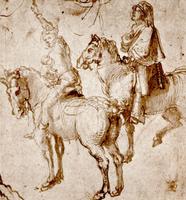
Studies by two riders
Albrecht Durer
Triumph of Wealth
Hans Holbein the Younger
Golgotha
Lucas van Leyden
Allegory of the Flourishing State of the United Provinces
Jan Saenredam
Couple on Horseback
Albrecht Durer
Noble woman at horses and Lansquenet
Albrecht Durer
The Dance of Saint Mary Magdalene
Lucas van Leyden
The Knight and the Landsknecht
Albrecht Durer
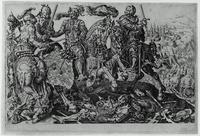
Conquest of Tunis (Victory of Charles V)
Maerten van Heemskerck
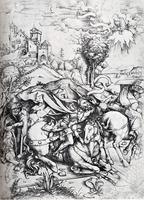
The Conversion Of St. Paul
Albrecht Durer
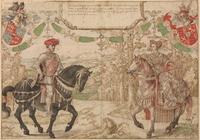
Johan Iv Van Nassau and His Wife Maria Van Loon-Heinsberg
Bernard Van Orley
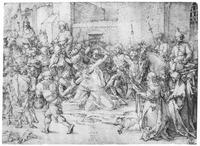
The Cross of Christ with Saint Veronica
Albrecht Durer
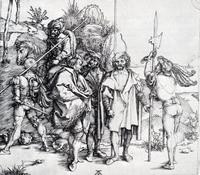
Five Lansquenets And An Oriental On Horseback
Albrecht Durer
Don Quixote
Gustave Dore
Lotz Itt is Antik Tárgyat Óhajtott, Félvén Attól, Hogy a Magyar Kultúra Történetéből Nem Lehet Elég Anyagot Meríteni
Károly Lotz
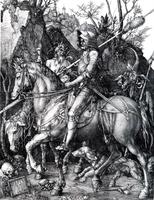
The Knight, Death and the Devil
Albrecht Durer
The Great Courier
Albrecht Durer