
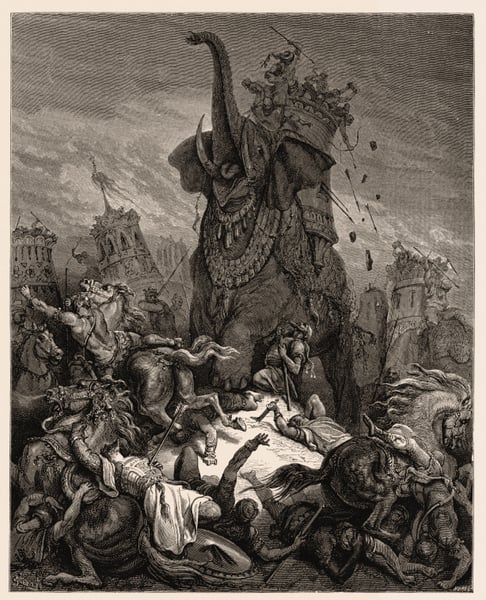
Gustave Dore sanatçısının Death of Eleazer eseri hakkında uzman analizi
Tarz: Romanticism · Tür: religious painting
Expert Analysis: "Death of Eleazer" by Gustave Doré
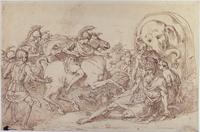
Gustave Doré’s Death of Eleazer stands as a compelling exemplar of Romantic religious painting, a genre in which the artist fused deep spiritual drama with the movement’s core ideals of intense emotion, heroic individualism, and sublime pathos. Though best known for his book illustrations, Doré brought to his canvas the same monumental sense of chiaroscuro and theatrical composition that defined his graphic work.
Significance within Romanticism:
The painting captures the martyrdom of Eleazer, the aged scribe from 2 Maccabees who chooses a painful death rather than betray his faith by eating pork. This subject epitomizes Romanticism’s fascination with the solitary hero confronting moral or physical annihilation. Doré emphasizes Eleazer’s stoic resolve through dramatic lighting—a stark beam illuminating his weathered face and raised hand, while shadow engulfs the jeering crowd. The contrast between the saint’s serene dignity and the chaotic, dimly lit mob heightens the emotional tension, a hallmark of Romantic chiaroscuro inherited from Caravaggio but pushed toward sublime extremity.
Religious and Narrative Power:
Unlike earlier religious works that often idealize martyrdom, Doré’s treatment is visceral and human. Eleazer’s body is shown collapsing, his robes tangled, his expression a mix of pain and transcendent calm. This duality—physical agony versus spiritual triumph—reflects the Romantic emphasis on the inner life over external doctrine. The composition thrusts the viewer into the moment of climax: hands reach out, a soldier wields a whip, yet the dying man’s gaze is fixed upward, bypassing his tormentors. This upward glance bridges the terrestrial and the divine, a device Doré used to convey faith as an active, dramatic force.
Doré’s Unique Contribution:
While rooted in the grand tradition of history painting, Death of Eleazer foreshadows later Symbolist and even cinematic sensibilities. Doré’s meticulous detail—the textures of skin, cloth, and stone—grounds the scene in gritty reality, while his sweeping diagonals and explosive light serve the Romantic obsession with the sublime. The work is significant precisely because it synthesizes academic religious iconography with the raw, subjective intensity that defines Romanticism at its peak. It reminds us that for Doré, the biblical was never static; it was a stage for the most profound human struggle.
Görsel olarak benzer
İlişkili kompozisyon ve renk paletine sahip 20 eser
The Death of Eleazar
Gustave Dore
Battle of Zama
Cornelis Cort
The Punishment of Antiochus
Gustave Dore
Pyrrhus Arrives in Italy with his Troupe
John Leech
David Attacks the Ammonites
Gustave Dore
The Israelites Slaughter the Syrians
Gustave Dore
The Death of Saul
Gustave Dore
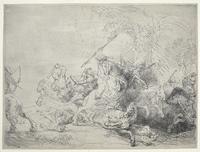
The large lion hunt
Rembrandt
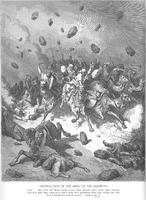
The Army of the Amorites Is Destroyed
Gustave Dore
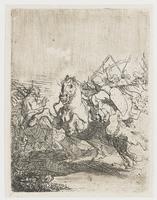
A cavalry fight
Rembrandt
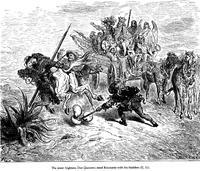
Don Quixote
Gustave Dore
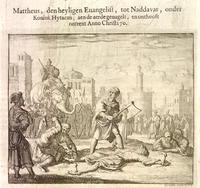
Evangelist Matthew Beheaded, Naddavar, Ethiopia, AD 70
Jan Luyken
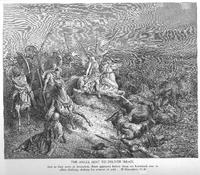
The Angel Is Sent to Deliver Israel
Gustave Dore
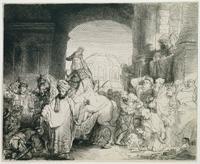
The triumph of Mordechai
Rembrandt
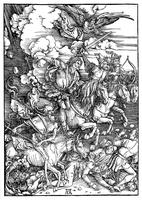
The Four Horsemen of the Apocalypse, Death, Famine, Pestilence and War
Albrecht Durer
A Heroine Florine of Burgundy
Gustave Dore
The Small Lion Hunt
Rembrandt
Richard I the Lionheart in battle at Arsuf in 1191
Gustave Dore
Self-possession of Fabricius, the Ambassador, under rather Trying Circumstances
John Leech
Alexander the Great and Porus
Vincenzo Camuccini