
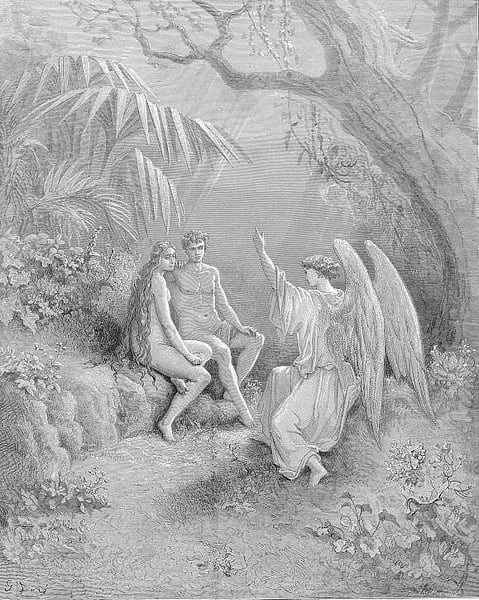
To whom the winged Hierarch replied O Adam, one Almighty is, from whom All things proceed
Dettagli
Analisi esperta di To whom the winged Hierarch replied O Adam, one Almighty is, from whom All things proceed di Gustave Dore
Stile: Romanticism · Genere: illustration
Art Historical Analysis: Gustave Doré’s Paradise Lost Illustration
Artwork: “To whom the winged Hierarch replied O Adam, one Almighty is, from whom All things proceed”
Artist: Gustave Doré
Style: Romanticism
Genre: Illustration
Significance within Romanticism and the Illustration Genre
Gustave Doré’s illustration for John Milton’s Paradise Lost is a quintessential example of how Romantic artists transformed literary imagery into monumental visual drama. The work is significant for three key reasons: its embodiment of the Romantic sublime, its mastery of narrative illustration, and its technical virtuosity in conveying cosmic scale through a static medium.
1. The Romantic Sublime
Doré captures the core Romantic preoccupation with the sublime—the awe-inspiring, often terrifying grandeur of nature and the divine. The composition plunges the viewer into a vast, cavernous space filled with swirling clouds, jagged rock formations, and radiant light. The “winged Hierarch” (the angel Raphael) and Adam are dwarfed by this overwhelming environment, emphasizing humanity’s insignificance before an infinite, omnipotent God. This contrast between the minute figures and the boundless, churning sky directly echoes Romantic painters like J.M.W. Turner and Caspar David Friedrich, who used scale and atmosphere to evoke spiritual and emotional transcendence.
2. Narrative Illustration as High Art
Doré elevates the illustration genre beyond mere accompaniment to Milton’s epic by encoding the poem’s theological argument into visual form. The line quoted in the title—“O Adam, one Almighty is, from whom All things proceed”—is rendered through a vertical composition that draws the eye upward, from the grounded Adam and the angel’s outstretched arm to a distant, blinding light source. This upward motion mirrors the poem’s hierarchical cosmology: all creation flows from a single divine source. Doré’s use of dramatic chiaroscuro (deep shadows vs. brilliant highlights) not only creates depth but also symbolizes the interplay of divine illumination and human ignorance. The illustration thus functions as a self-contained visual sermon, making abstract theology tangible.
3. Technical and Atmospheric Mastery
As a wood engraver, Doré achieves an extraordinary range of texture and tonal variation. The rough, swirling lines of the rock faces contrast with the soft, diaphanous clouds, while the figures are rendered with precise, linear clarity. This interplay of solid and ethereal forms heightens the sense of a transcendent, otherworldly dialogue. The composition’s asymmetry—the angel on the left, Adam on a lower right ledge, and the vast empty space between them—creates a dynamic tension that propels the narrative forward, even within a single frame. This method became a hallmark of Doré’s illustrative style and influenced subsequent generations of book illustrators, from Arthur Rackham to modern graphic novelists.
Conclusion
Doré’s Paradise Lost illustration transcends its genre by fusing Romantic emotion with intellectual precision. It remains a landmark of 19th-century visual culture, demonstrating how illustration can achieve the same grandeur and philosophical weight as painting or sculpture. The work’s enduring power lies in its ability to make the infinite feel immediate—a core achievement of the Romantic spirit.
Visivamente simili
20 opere con composizione e palette affini
Poème de l'âme 12: L’Échelle d’or
Louis Janmot
Back to the thicket slunk The guilty serpent
Gustave Dore
Eastward amoung those trees, what glorious shape Comes this way moving
Gustave Dore
They heard, And from His presence hid themselves amoung The thickest trees
Gustave Dore
So parted they the Angel up to heaven From the thick shade, and Adam to his bower
Gustave Dore
Nyads and Dryads
Walter Crane
The Creation of Eve
Gustave Dore
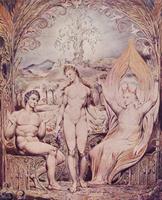
Archangel Raphael with Adam and Eve
William Blake
São Mateus Evangelista
Nicolas Antoine Taunay
Oberon, Titania and Puck with Fairies Dancing
William Blake
The savoury pulp they chew, and in the rind, Still as they thirsted, scoop the brimming
Gustave Dore
Allegory of Life
Pierre Puvis de Chavannes
Evening and Sorrow
Gustave Moreau
Love's Passing
Evelyn De Morgan
Nymphs
Henri-Pierre Picou
The Sacred Wood Cherished by the Arts and the Muses (detail)
Pierre Puvis de Chavannes
The Swan Maidens
Walter Crane
The Sacred Wood Cherished by the Arts and the Muses (detail)
Pierre Puvis de Chavannes
Landscape with Satyrfamilie
Albrecht Altdorfer
The Summer Diana Surprised by Actaeon
Eugene Delacroix