
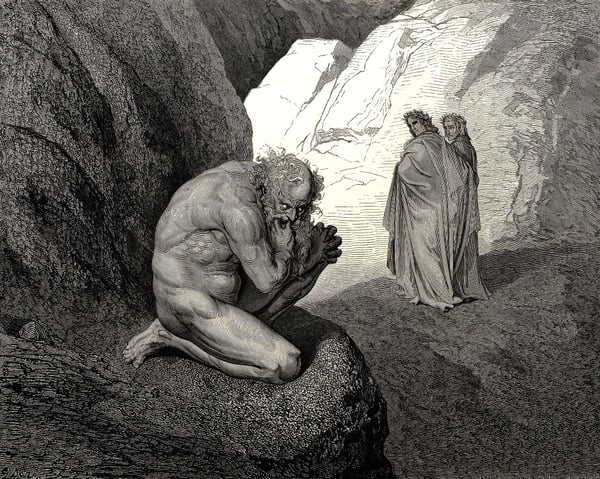
Expertenanalyse zu Gustave Dores The Inferno, Canto 7
Stil: Romanticism · Genre: illustration
Expert Analysis: "The Inferno, Canto 7" by Gustave Doré
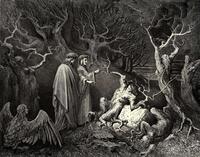
Gustave Doré’s illustration for Canto 7 of Dante’s Inferno stands as a masterwork of Romantic visual storytelling, combining the period’s fascination with the sublime, the grotesque, and the emotionally overwhelming. Within the Romantic style, Doré amplifies Dante’s allegorical vision by translating poetic terror into a dense, chiaroscuro-driven engraving that feels both ancient and immediate.
What makes the work significant within Romanticism:
Romanticism prized the individual’s encounter with nature’s majesty and human passion—often in extreme, dark forms. Doré’s depiction of the Fifth Circle (the swampy Styx, where the wrathful and slothful suffer) epitomizes this. The scene is not merely descriptive but emotionally charged: billowing clouds, jagged lightning, and turbulent water create a landscape that mirrors inner torment. The writhing figures—some locked in combat, others sinking in despair—are rendered with theatrical intensity. This is the Romantic sublime: awe mixed with horror, where the viewer feels dwarfed by a cosmic, punitive order.
What makes the work significant as an illustration:
Doré’s genius lies in his ability to compress Dante’s layered narrative into a single, readable image without losing complexity. Canto 7 features the wrathful tearing at each other and the slothful submerged in mud. Doré subtly differentiates these groups: the violent struggles occur in the foreground, while prone, nearly invisible forms lurk in the murk—a visual hierarchy that guides the eye and reinforces the canto’s moral distinctions. His use of deep shadow and stark highlights creates a claustrophobic atmosphere, making the page feel like a window into a suffocating afterlife. This illustration, part of his iconic 1861 edition of the Divine Comedy, set a standard for literary illustration, proving that a printed image could match—and sometimes surpass—the poem’s visceral impact. Doré’s work remains a touchstone for how Romantic drama can serve textual narrative, blending faithful adaptation with bold artistic interpretation.
Visuell ähnlich
20 Werke mit ähnlicher Komposition und Farbpalette
Pluto and Virgil
Gustave Dore
Geri Del Bello
Gustave Dore
The Inferno, Canto 12
Gustave Dore
The Inferno, Canto 28
Gustave Dore
Schismatics--Mahomet
Gustave Dore
Forgers II
Gustave Dore
Bertram De Born
Gustave Dore
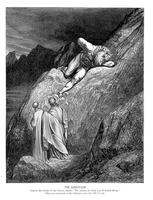
The Minataur
Gustave Dore
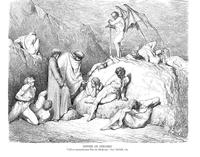
Sower of Discord
Gustave Dore
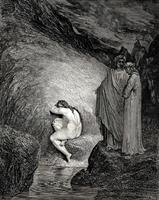
The Inferno, Canto 30
Gustave Dore
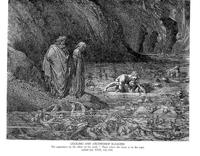
Ugolino and Archbishop Ruggieri
Gustave Dore
Thais
Gustave Dore
The Giant Antaeus
Gustave Dore
The Inferno, Canto 15
Gustave Dore
The Inferno, Canto 32
Gustave Dore
St Jerome Penitent in the Wilderness
Cornelis Cort
Sheet of Studies with St. Jerome, Seated at Right and Resting His Right Forearm on a Book, at Left An Ecclesiastical Figure Wearing a Cope and Miter, and at Bottom Two Putti
Palma il Giovane
Ephialtes
Gustave Dore
The Inferno, Canto 18
Gustave Dore
The Inferno, Canto 13
Gustave Dore