
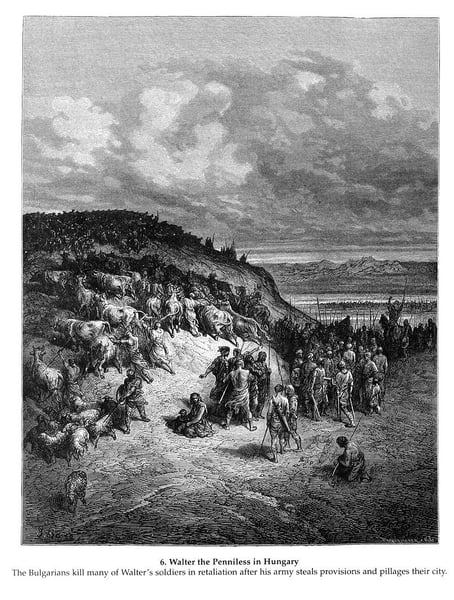
Analisi esperta di Walter the Penniless in Hungary di Gustave Dore
Stile: Romanticism · Genere: illustration
Expert Art Historical Analysis: "Walter the Penniless in Hungary" by Gustave Doré
Style & Significance:
Executed in the Romantic style, this illustration captures the movement’s core tenets: emotional intensity, dramatic tension, and a fascination with historical or exotic subjects. Doré, a master of Romantic visual storytelling, uses the illustration genre to transform a historical episode into a visceral, almost theatrical tableau. The work is significant for its ability to condense the grand, turbulent spirit of Romanticism into a single, densely packed scene—typical of Doré’s skill in making narrative moments feel monumental and charged with psychological depth.
Key Romantic Features (Inferred from Stylistic Context):
- Dynamic Composition & Chiaroscuro: Doré likely employs stark contrasts of light and shadow to heighten the sense of struggle or desperation, directing the viewer’s eye to the central figure of Walter and his ragged followers. That push-pull of illumination embodies Romanticism’s obsession with the sublime and the precarious.
- Emotional Intensity: The title itself—“Walter the Penniless in Hungary”—evokes poverty, determination, and the arduous journey of the First Crusade (popularly mythologized in the 19th century). Doré’s illustration would emphasize the heroism and suffering of the common crusader, aligning with Romanticism’s interest in the individual versus overwhelming fate.
- Historical Sublime: As Romantic illustration, the work bridges fine art and popular print culture, making a medieval subject accessible while preserving its epic, almost mythic quality. Doré’s rendering elevates Walter from a minor historical figure to a symbol of doomed or noble perseverance.
Conclusion:
This piece stands as a prime example of how Doré harnessed Romanticism’s visual language to breathe life into history. Its significance lies in its fusion of narrative clarity (the illustrator’s duty) with Romantic excess—a combination that would influence book illustration and historical painting for decades.
Visivamente simili
20 opere con composizione e palette affini
Samson Destroys the Philistines with an Ass' Jawbone
Gustave Dore
Surprised by the Turks
Gustave Dore
Combat between Soldiers of Ish-bosheth and David
Gustave Dore
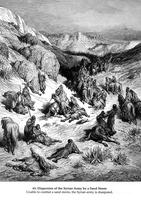
Dispersion of the Syrian Army by a Sand Storm
Gustave Dore
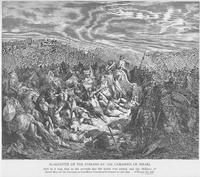
The Israelites Slaughter the Syrians
Gustave Dore
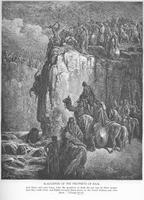
The Prophets of Baal Are Slaughtered
Gustave Dore
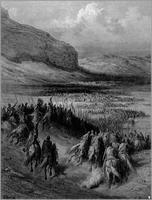
Ottomans penetrate Hungary
Gustave Dore
Tyburn Large
William Hogarth
Crusade against the moors of Granada
Gustave Dore
Six Battle Scenes
Achille Louis Martinet
Two Hundred Knights Attack Twenty Thousand Saracens
Gustave Dore
The army of the Second Crusade find the remains of the soldiers of the First Crusade
Gustave Dore
Destruction at Damascus of the Army of Conrad III of Germany
Gustave Dore
The War Cry of the Crusaders
Gustave Dore
The Death of Ahab
Gustave Dore
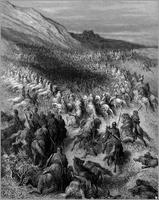
Crusaders surrounded by Saladin's army
Gustave Dore
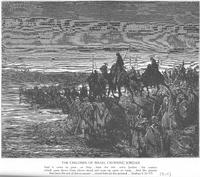
The Israelites Cross the Jordan River
Gustave Dore
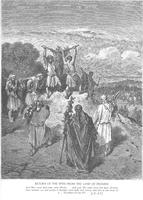
The Spies Return from the Promised Land
Gustave Dore
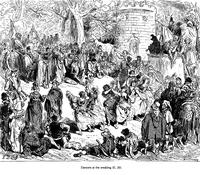
Don Quixote
Gustave Dore
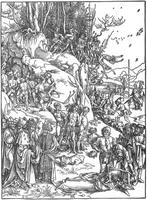
Martyrdom of the Ten Thousand
Albrecht Durer