Analisi esperta di Garden of the Louvre Snow Effect di Camille Pissarro
Stile: Impressionism · Genere: cityscape
Expert Art Historical Analysis: "Garden of the Louvre Snow Effect" by Camille Pissarro
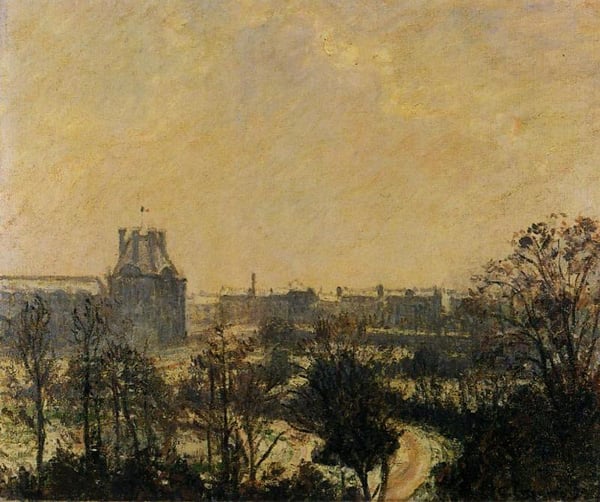
Camille Pissarro’s Garden of the Louvre Snow Effect (c. 1900) exemplifies the core ambitions of Impressionism while also revealing the artist’s unique contribution to the movement. As a cityscape executed in the Impressionist style, the painting captures a fleeting winter moment in one of Paris’s most iconic public spaces—the Tuileries Garden adjacent to the Louvre. What makes this work significant is its masterful synthesis of two key Impressionist preoccupations: the depiction of transient atmospheric conditions (snow) and the modern urban landscape.
Pissarro, often called the “father of Impressionism,” was the only artist to exhibit in all eight Impressionist exhibitions. Here, he applies the movement’s signature broken brushwork and high-keyed palette to render the subtle effects of snow on an enclosed garden. The “snow effect” was a favorite Impressionist subject because it forced artists to observe how light reflected off a white surface, blurring edges and muting local colors. Pissarro’s canvas is a study in tonal harmonies: pale lavender shadows, soft grays, and muted ochres convey the chill and muffled quiet of a wintry day. The garden’s statues and carefully pruned trees are rendered with swift, dappled strokes that dissolve form into atmosphere—a hallmark of plein-air observation.
The cityscape genre here is significant because it situates Impressionism within the modernity of Haussmann’s Paris. By choosing the Louvre’s garden—a symbol of royal and then republican cultural authority—Pissarro transforms a familiar, almost clichéd view into a meditation on light and perception. The work subtly contrasts the geometric order of the formal garden (the aligned trees, the distant pavilion) with the organic, flickering application of paint. This tension between structured subject and unstructured technique embodies Impressionism’s revolutionary approach: seeing the world not as fixed objects but as fluid, sensory experiences.
In the context of Pissarro’s late career, the painting also reflects his shift toward a more structured composition influenced by Seurat and Cézanne, yet it retains the spontaneity that defines early Impressionism. Garden of the Louvre Snow Effect thus serves as a bridge—demonstrating how Impressionism evolved from pure optical sensation to a more deliberate, yet still atmospheric, engagement with the urban environment. Its significance lies in its ability to make the ordinary extraordinary, capturing a moment of quiet beauty through the radical lens of color, light, and fleeting time.
Museum / Gallery
Visivamente simili
20 opere con composizione e palette affini
Garden of the Louvre Fog Effect
Camille Pissarro
The Tuileries Gardens
Camille Pissarro
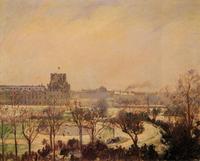
The Tuileries Gardens Snow Effect
Camille Pissarro
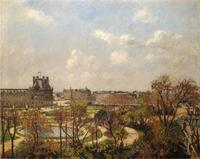
The Garden of the Tuileries, Morning, Spring
Camille Pissarro
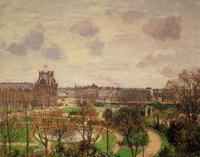
Garden of the Louvre Morning, Grey Weather
Camille Pissarro
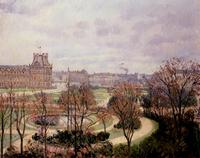
View of the Tuileries, Morning
Camille Pissarro
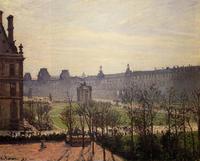
The Carrousel, Autumn, Morning
Camille Pissarro
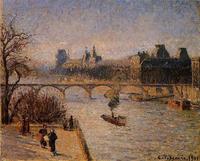
The Louvre 2
Camille Pissarro
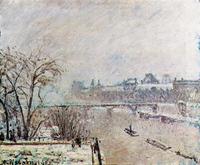
The Seine Viewed from the Pont Neuf, Winter
Camille Pissarro
Hyde Park
Claude Monet
The Tuileries (Study)
Claude Monet
View of the Seine from the Raised Terrace of the Pont Neuf
Camille Pissarro
The Seine and the Louvre, Paris
Camille Pissarro
White Frost
Gustave Loiseau
Morning, Autumn Sunlight, Eragny
Camille Pissarro
The Louvre and the Seine from the Pont Neuf
Camille Pissarro
The Tuileries and the Louvre
Camille Pissarro
Les Inondations De 1910, Le Pavillon De Flore
Maximilien Luce
The Carrousel, Grey Weather
Camille Pissarro
The Louvre, Afternoon
Camille Pissarro