
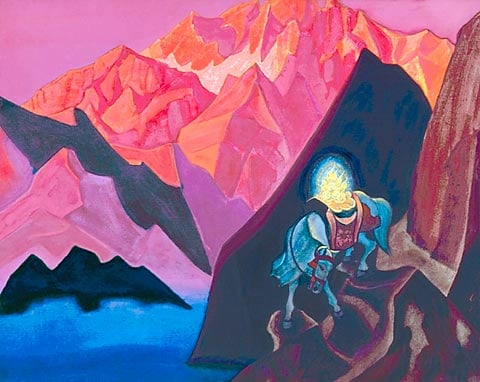
A depiction of the Cintamani being carried by the Lung Ta (Wind Horse)
Dettagli
Analisi esperta di A depiction of the Cintamani being carried by the Lung Ta (Wind Horse) di Nicholas Roerich
Stile: Symbolism · Genere: mythological painting
This artwork, A depiction of the Cintamani being carried by the Lung Ta (Wind Horse) by Nicholas Roerich, is a quintessential example of Symbolist painting filtered through the artist’s deep engagement with Eastern spiritual traditions. The work’s significance lies in how Roerich synthesizes Symbolism’s core ambition—to evoke transcendent, inner realities through metaphor and dreamlike imagery—with specific mythological iconography that bridges Buddhist cosmology and the Theosophical ideas popular among early 20th-century avant-garde artists.
Symbolist handling of myth: Where many Symbolists (e.g., Moreau, Redon) drew from Greco-Roman or biblical myths, Roerich turns to Central Asian and Himalayan sources. The Cintamani (a wish-fulfilling jewel) and the Lung Ta (a Tibetan wind horse) are not mere decorative elements; they function as visual catalysts for spiritual ascent. In Symbolist theory, the artwork should suggest an “invisible world” beyond surface reality. Here, the jewel is not just an object but a symbol of enlightened consciousness, while the wind horse represents the energy (prana) that carries that consciousness across realms.
Compositional and color significance: Roerich’s palette (likely blues, whites, and golden highlights) reflects the Symbolist preference for non-naturalistic, emotionally charged color. The sweeping motion of the Lung Ta—a horse without physical legs, often shown as a wind-blown silhouette—embodies the Symbolist belief in correspondences between the visible and invisible. The jewel’s radiant glow would act as a focal point, drawing the viewer’s eye upward, suggesting a journey from the material to the spiritual.
Historical context: Painted during Roerich’s years of Central Asian expeditions (1920s–30s), this work exemplifies his role as a bridge between Western Symbolism and Eastern esotericism. It is significant because it rejects the pessimism and decadence often associated with Symbolism, instead offering an optimistic, active spiritual path. The Cintamani and Lung Ta together create a visual mantra: enlightenment is carried on the winds of inner energy. This places the work within the Symbolist subcurrent that aimed to use myth as a tool for personal and collective transformation—a goal Roerich pursued through his art, writings, and the Roerich Pact.
In sum, the artwork’s importance lies in its perfect fusion of Symbolist mysticism with Tibetan Buddhist imagery, creating a visual statement that transcends cultural boundaries. It stands as a testament to Roerich’s ability to make ancient myths vibrantly present, inviting viewers to see not just a jewel and a horse, but a vision of spiritual awakening.
Visivamente simili
20 opere con composizione e palette affini
Order of Rigden Jyepo
Nicholas Roerich
World's Treasure (Cintamani)
Nicholas Roerich

Marvelous miracle (To the feat)
Nicholas Roerich
He who hastens
Nicholas Roerich

Pilgrim
Nicholas Roerich
Order of Rigden Jyepo
Nicholas Roerich
Oirot Messenger of the White Burkhant
Nicholas Roerich

Lahaul
Nicholas Roerich

Mother of Genghis Khan
Nicholas Roerich
Fires of victory (Sentinel lights on the towers in Gobi)
Nicholas Roerich
Compassion
Nicholas Roerich
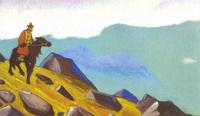
Genghis Khan
Nicholas Roerich

Song of Shambhala
Nicholas Roerich
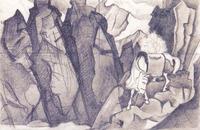
World's Treasure
Nicholas Roerich
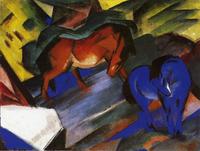
Red and Blue Horse
Franz Marc

Kuluta
Nicholas Roerich
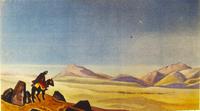
Mongolian horseman
Nicholas Roerich
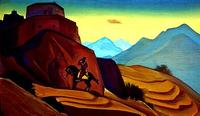
Hystaspes. Shahnameh.
Nicholas Roerich
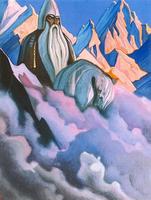
Svyatogor
Nicholas Roerich
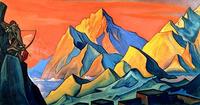
Message from Shambhala (Arrow-letter)
Nicholas Roerich