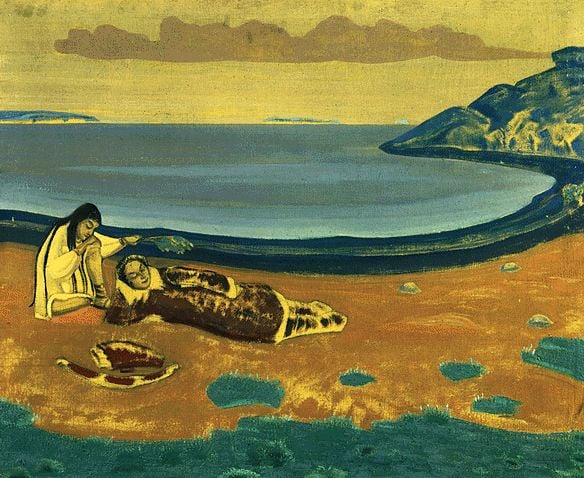
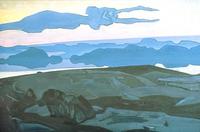
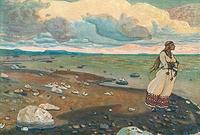
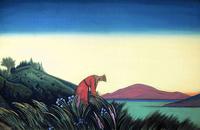
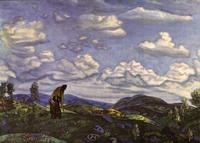
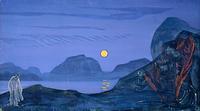
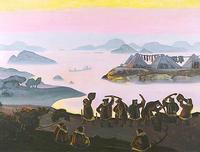
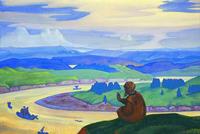
Nicholas Roerich’s “Hunter’s Dream” stands as a compelling example of Symbolist genre painting, where the artist transforms a seemingly ordinary scene into a portal to the inner, spiritual world. The work’s significance lies in its fusion of the everyday—a hunter resting or sleep—with the Symbolist preoccupation with dreams, mysticism, and the unseen forces of nature. Rather than simply recording a moment of rural life, Roerich imbues the composition with a numinous quality: the landscape itself may pulse with hidden energies, and the hunter’s dream becomes a conduit for ancestral or cosmic visions. This approach elevates the genre painting from anecdotal realism to a meditative symbol, characteristic of Roerich’s broader oeuvre that seeks to bridge the physical and the metaphysical. In the context of Symbolism, “Hunter’s Dream” exemplifies how artists of the movement used familiar motifs—here, a hunter in the wild—as vehicles for exploring the subconscious, memory, and the spiritual essence of the natural world.