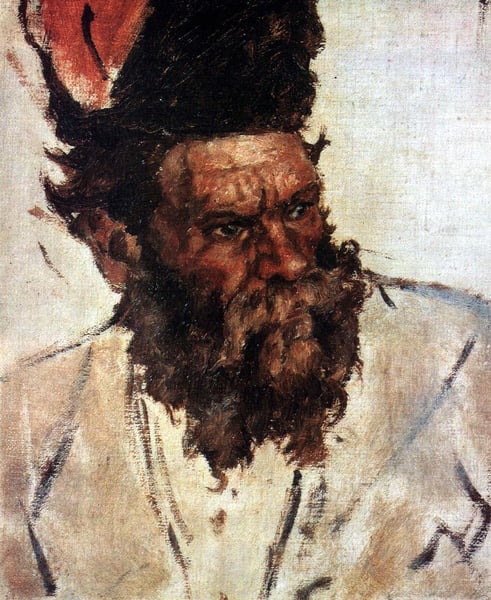
Don Cossack Rjidin (Study to "The Conquest of Siberia by Yermak")
Dettagli
Analisi esperta di Don Cossack Rjidin (Study to "The Conquest of Siberia by Yermak") di Vasily Surikov
Stile: Realism · Genere: sketch and study
This study by Vasily Surikov is a revealing window into the working methods of one of Russia’s most celebrated Realist history painters. As a preparatory sketch for his monumental canvas The Conquest of Siberia by Yermak (1895), this work is significant for two primary reasons: it demonstrates Surikov’s rigorous commitment to ethnographic accuracy, and it offers insight into the Realist process of building a grand historical narrative from intimate, character-driven details.
Ethnographic Authenticity within the Realist Tradition
Surikov believed that capturing the spirit of history required precise knowledge of its participants. For The Conquest of Siberia, he made extensive studies of Cossack types and costumes, often seeking out living descendants of the original Don Cossacks. This study of “Rjidin” — likely a nickname or surname indicating a specific individual — is not a generic figure but a portrait in its own right. The artist’s hand renders the weathered face, the specific cut of the fur hat, and the coarse texture of the coat with an almost documentary fidelity. This aligns with the core tenet of 19th-century Realism: to represent the world truthfully, without idealization. For Surikov, truth meant showing the exact appearance of the Cossack warriors who, under Yermak Timofeyevich, crossed the Urals into Siberia in the 1580s.
The Study as a Foundational Step in Grand History Painting
The genre of “sketch and study” was crucial to Surikov’s method. Unlike the finished canvas, which orchestrates a chaotic battle scene of hundreds of figures, this drawing focuses on a single, still individual. The significance lies in how Surikov built his epic compositions from the bottom up: by first establishing the physical and psychological presence of each person. The rough, unfinished quality of the paper and the rapidly drawn strokes highlight the artist’s search for character—the tilt of the head, the set of the jaw. This study is not a discarded idea but a preserved building block. It allows us to witness Surikov transforming a living model into a historical actor, a process that bridges the gap between empirical observation and historical imagination.
National Identity and the Realist Gaze
Finally, the subject matter itself carries weight. Don Cossacks were a frontier warrior class, portrayed by Surikov not as romanticized heroes but as hardened, pragmatic men. In the context of Russian Realism, which often explored themes of national identity and the common people, this study contributes to Surikov’s larger project: reclaiming the rugged, collective force behind Russia’s expansion. The unfinished state of the drawing emphasizes the rawness of that force. The artwork thus stands as a testament to Realism’s ambition to document the overlooked participants of history with dignity and precision, making Surikov’s preparatory studies as artistically and historically vital as the final masterpieces they served.
Visivamente simili
20 opere con composizione e palette affini
Portrait of the painter Giuseppe Garzolini
Umberto Veruda
Head of a Man
Ilya Repin
Portrait of Edouard Vuillard
Felix Vallotton
Self-portrait with white turbaned
Paul Cezanne
Self-portrait
Paul Cezanne
Portrait of Victor Chocquet
Paul Cezanne
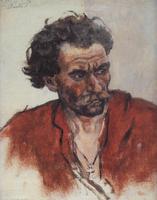
Cossack with red shirt
Vasily Surikov
Portrait of Poly, fisherman at Kervillaouen
Claude Monet
Portrait of Isidore Gauguin
Paul Gauguin
Self-Portrait with a Beret
Claude Monet
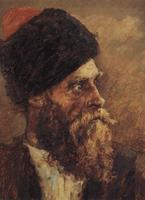
Cossack Dmitry Sokol
Vasily Surikov
Self-portrait with white turbaned (detail)
Paul Cezanne
Portrait of the Author Vladimir Korolemko
Ilya Repin
Self-Portrait
Paul Cezanne
Auto-Retrato
Antonio Carneiro
Portrait of Monsieur Louis Estruc
Camille Pissarro
Portrait of Pierre Broodcoorens
Rene Magritte
Self-Portrait in a Casquette
Paul Cezanne
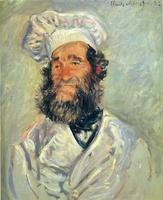
Portrait of Pere Paul
Claude Monet
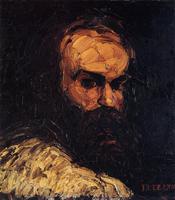
Self-Portrait
Paul Cezanne