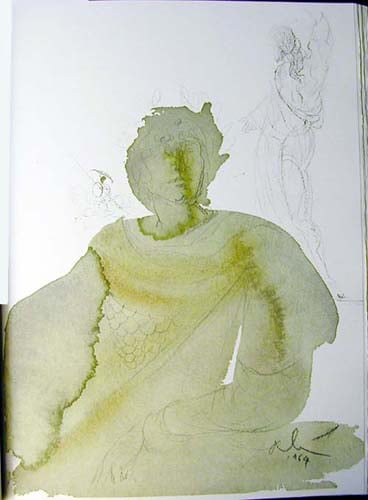
Licet tributum dare Caesari?
Details
Expertenanalyse zu Salvador Dalis Licet tributum dare Caesari?
Stil: Expressionism, Symbolism · Genre: religious painting
Expert Analysis of Salvador Dalí’s “Licet tributum dare Caesari?” (c. 1941–1989)
Dalí’s “Licet tributum dare Caesari?” — Latin for “Is it lawful to pay tribute to Caesar?” — is a significant religious painting from the artist’s Classic Period (1941–1989). During these decades, Dalí moved away from the overtly surrealist provocations of his youth toward a synthesis of mystical symbolism, technical precision, and Renaissance-inspired composition, while retaining the psychological depth of Expressionism.
The work reinterprets the biblical episode of the Pharisees’ trap question to Christ (Matthew 22:15–22), in which Jesus famously replies, “Render unto Caesar the things that are Caesar’s, and unto God the things that are God’s.” Dalí’s addition of a question mark in the title turns the doctrinal dilemma into a personal, existential inquiry—a hallmark of his mature spiritual phase.
Key Significance Within Style & Period
-
Expressionist & Symbolist Fusion
Though often labeled a Surrealist, Dalí’s Classic Period paintings employ expressionist distortions to convey anguish and doubt. Here, the figures likely appear elongated or fragmented, their faces contorted in debate, while the background dissolves into a symbolist dreamscape of melting coins, imperial eagles, or cryptic geometric forms. The coin itself—the denarius bearing Caesar’s image—becomes a charged symbol of worldly power versus divine sovereignty. -
Religious Genre as Philosophical Theater
Unlike the serene devotional works of earlier masters, Dalí’s religious painting is agonistic and theatrical. He stages the confrontation as a psychological drama: Christ stands not as a tranquil sage but as a figure under existential pressure, while the Pharisees are rendered almost as spectral, materialistic shadows. This aligns with Dalí’s own “nuclear mysticism,” where science and faith collide. -
Technical Mastery of the Classic Period
After 1941, Dalí rejected automatic painting for meticulous, academic brushwork inspired by Raphael and Vermeer. In “Licet tributum dare Caesari?”, light may fall with hyperreal clarity, illuminating textures of skin, cloth, and metal, while the composition echoes Leonardo’s Last Supper—a symmetrical, perspective-driven stage that anchors the absurd in the plausible. This paradox (surreal content + classical form) is the work’s core significance: Dalí proves that religious doubt can be rendered with the rigor of Old Master painting. -
Temporal & Existential Commentary
Created during the Cold War and Dalí’s own turn to Catholicism, the painting transcends its biblical source to ask if art, authority, and belief can coexist. The raised question mark (embedded in the composition or implied by the title) mirrors the artist’s own struggle—how to serve both the Caesar of commercial surrealism and the God of transcendent art?
In summary, “Licet tributum dare Caesari?” is notable not as a literal illustration but as a symbolist-existential interrogation draped in expressionist intensity and classical technique. It marks Dalí’s mature reconciliation of faith, doubt, and art—a dialogue between the material and the divine that defines his Classic Period legacy.
Visuell ähnlich
20 Werke mit ähnlicher Komposition und Farbpalette
Illustration # 9
Maria Bozoky
Spiritus promptus est, caro vero infirma
Salvador Dali
Tiburtine Sibyl
Orest Kiprensky
Two girls. Sketch
Hryhorii Havrylenko
Carolina
Alberto Giacometti
Hircus caprarum super faciem terrae
Salvador Dali
Etude Pour "Les Pèlerins D’emmaüs"
Paul Leroy
Child
Aubrey Beardsley
Strolling figure
Nicholas Roerich
Cassive (Jeanne Hading)
Henri de Toulouse-Lautrec
Marin and student
Pablo Picasso
Seduxisti me, Domine
Salvador Dali
Issa and giant's head
Nicholas Roerich
A young woman with black hair, gazing towards the sky
Anton Romako
Character study
Ferdinand Hodler
Queen Marie Antoinette on the way to her execution
Jacques-Louis David
Ecce virgo concipiet (Isaiah 7:14)
Salvador Dali
Female Portrait and Sketches of Hands
Konstantin Somov
Mariae annunciato (Luke 1:26f)
Salvador Dali
Sitting Mary with child
Albrecht Durer