Expert analysis of Konrad Witz’s St. Catherine and Mary Magdalene
Style: Northern Renaissance · Genre: religious painting
Expert Analysis: "St. Catherine and Mary Magdalene" by Konrad Witz
Konrad Witz’s St. Catherine and Mary Magdalene exemplifies the groundbreaking naturalism of the Northern Renaissance, merging devotional intensity with a keen observation of the material world. As a religious painting from this period, its significance lies in Witz’s pioneering approach to landscape, light, and human form—qualities that set him apart from his contemporaries and influenced the course of German and Swiss painting.
Stylistic and Technical Significance
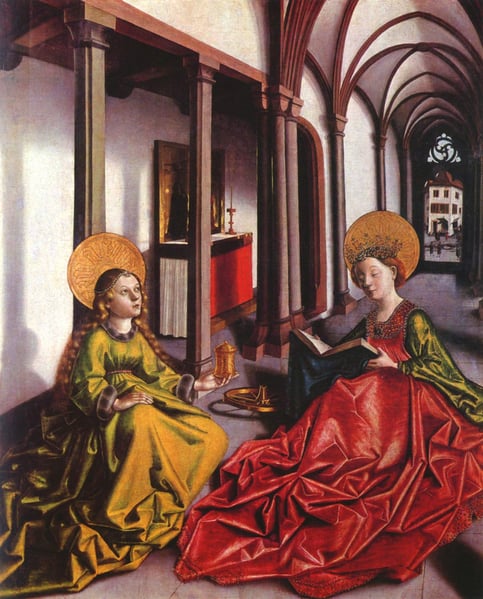
Witz is celebrated as one of the first Northern European artists to accurately depict a specific, identifiable landscape background. In this work, the two saints are set against a meticulously rendered environment, likely inspired by the Lake Geneva region. The atmospheric perspective—softening distant hills and clouds—creates a convincing sense of depth, while the sharp, detailed handling of foreground elements (such as foliage, fabrics, and the saints’ attributes) demonstrates Witz’s mastery of oil paint to capture textures, from the gleaming metal of St. Catherine’s wheel to the soft folds of Mary Magdalene’s robe.
Iconographic and Compositional Choices
St. Catherine of Alexandria, identifiable by her attribute of the spiked wheel, and Mary Magdalene, often shown with a jar of ointment, are presented as contemplative yet physically present figures. Witz rejects the idealized, ethereal quality of earlier Gothic art in favor of individualized features and a naturalistic sense of volume. The two saints are arranged in a balanced, intimate grouping—their gazes and gestures suggesting a quiet dialogue or shared devotion, rather than a hierarchical or narrative scene. This humanization of sacred figures was a hallmark of Northern Renaissance piety, making the divine accessible and relatable.
Context and Legacy
Painted around 1440–1445, this work belongs to Witz’s mature period, when he produced the famous Miraculous Draft of Fishes (1444) for the St. Peter Altarpiece in Geneva. Like that masterpiece, St. Catherine and Mary Magdalene reveals Witz’s obsession with the integration of figures into a believable, luminous space—a radical departure from the flat gold grounds of earlier altarpieces. His careful study of light and shadow, and his ability to render the play of sunlight on different surfaces, anticipate the achievements of later Northern masters such as Jan van Eyck and Rogier van der Weyden.
Conclusion
The significance of St. Catherine and Mary Magdalene lies in its synthesis of spiritual meaning and empirical observation. Witz elevates a traditional religious subject by grounding it in the tangible world, offering viewers a vision of holiness that is both intimate and deeply connected to the natural environment. This work stands as a key example of the Northern Renaissance’s shift toward realism, where the sacred and the everyday coexist in quiet, profound harmony.
Visually similar
20 works with related composition and palette
Madonna and Saints in a Church
Konrad Witz
The Presentation in the Temple
Raphael
The Holy Kinship
Geertgen tot Sint Jans
Annunciazione
Francesco Botticini
The Annunciation
Jan van Eyck
Annunciation
Konrad Witz
Pala di Fano (Annunciation)
Pietro Perugino
The Annunciation (left wing of the Isenheim Altar)
Matthias Grünewald
Virgin and Child Enthroned with two Musical Angels
Hans Memling
The Announcement to Anne and Joachim
Bernhard Strigel
The Adoration of the Magi
Konrad Witz
St. Luke Drawing a Portrait of the Virgin Mary
Rogier van der Weyden
The Virgin of the Chancellor Rolin
Jan van Eyck
Annunciation
Fra Angelico
Christ's dispute at the Temple
Defendente Ferrari
Adoration of the Magi: Right wing of triptych, depicting the Presentation in the Temple, c.1470-72 (oil on panel)
Hans Memling
Seven Sacraments Altarpiece
Rogier van der Weyden
Birth tray
Masaccio
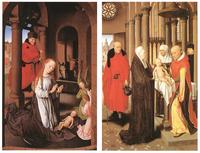
Wings of a Triptych
Hans Memling
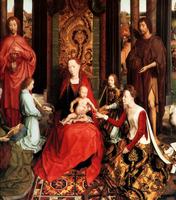
Triptych of the Mystical Marriage of St. Catherine of Alexandria, central panel: Marriage of St. Catherine
Hans Memling