
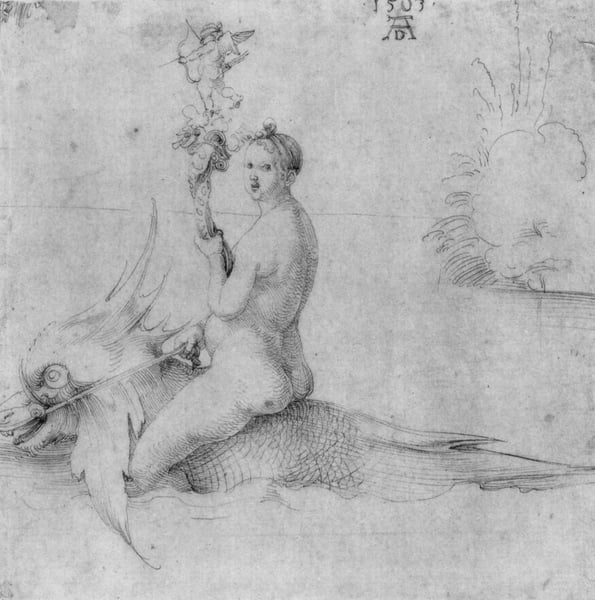
Analisi esperta di Venus on a dolphin di Albrecht Durer
Stile: Northern Renaissance · Genere: mythological painting
Expert Art Historical Analysis: Venus on a Dolphin by Albrecht Dürer
This work by Albrecht Dürer stands as a seminal example of the Northern Renaissance’s engagement with classical mythology, demonstrating how the artist synthesized Italian humanist ideals with the meticulous naturalism of the North. Dürer, a master printmaker and painter, was among the first Northern artists to fully embrace mythological subjects—a departure from the region's dominant religious iconography.
Significance within the Northern Renaissance
The painting (likely an engraving or drawing, as Dürer excelled in graphic media) showcases the Northern Renaissance’s hallmark attention to detail, texture, and precise linework. Dürer renders Venus’s flowing hair, the dolphin’s scaled body, and the surrounding landscape with extraordinary specificity, grounding a mythic scene in tangible reality. This contrasts with the softer, more idealized forms of contemporary Italian works—Dürer’s Venus retains a tangible, almost anatomical presence, reflecting the Northern preoccupation with empirical observation.
Mythological Innovation
By choosing Venus—goddess of love and beauty—astride a dolphin, Dürer revives a classical trope (Venus Anadyomene or her sea-borne birth) but interprets it through a distinctly Northern lens. The subject signals the artist’s engagement with Renaissance humanism and the revival of ancient literature, likely inspired by Italian sources or prints he encountered during his travels. Unlike many Northern artists who allegorized myth within moralizing Christian frameworks, Dürer presents the scene with unabashed secular sensuality, celebrating the beauty of the human form and the natural world.
Technical Mastery and Influence
Dürer’s handling of line—whether in a drawing or as a preparatory study for an engraving—reveals his genius for creating volume and texture through cross-hatching and delicate contours. The composition balances the dynamic curve of the dolphin with the graceful pose of Venus, a harmony typical of the High Renaissance yet executed with the precision of a Northern goldsmith. This work exemplifies Dürer’s role as a bridge between worlds: he imported the intellectual and formal innovations of the Italian Renaissance into the North, while retaining the meticulous craftsmanship that would define German art for generations.
Conclusion
Venus on a Dolphin is significant because it marks a key moment in the Northern Renaissance’s shift from exclusively religious to mythological subjects, demonstrating Dürer’s pioneering ability to fuse classical idealism with Northern realism. It stands as a testament to his role as a cultural translator, whose work both absorbed and transformed the Renaissance across the Alps.
Museum / Gallery
Visivamente simili
20 opere con composizione e palette affini
Galatea on a sea monster
Giovanni Battista Piranesi
Arion
Albrecht Durer
Amphitrite
Giovanni Battista Piranesi
The Dead Christ
Hans Baldung
Cleopatra to death with the asp by Guercino
Giovanni Battista Piranesi
Study Journal, naked couple and the Devil
Albrecht Durer
Night Startled by the Lark
William Blake
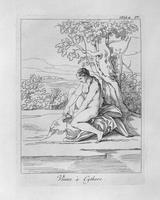
Venus in Kythera
Giovanni Battista Piranesi
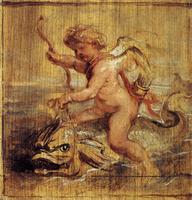
Cupid Riding a Dolphin
Peter Paul Rubens
Religion of Priapus
Agostino Carracci
Molorchos making a sacrifice to Hercules
Andrea Mantegna
The Birth of Venus
Giovanni Battista Piranesi
Wild woman with shield
Martin Schongauer
Adam and Eve
Albrecht Durer
Tranformism
Felicien Rops
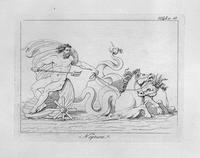
Neptune
Giovanni Battista Piranesi
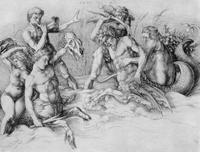
Fighting Seekentauren
Albrecht Durer
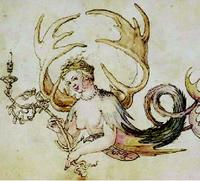
The chandelier females
Albrecht Durer
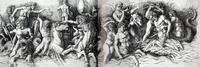
The Battle of Sea Gods
Andrea Mantegna
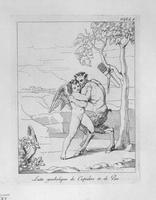
Symbolic struggle of Cupid and Pan
Giovanni Battista Piranesi