
Analisi esperta di Cocytus--Traitors di Gustave Dore
Stile: Romanticism · Genere: illustration
Expert Analysis of "Cocytus—Traitors" by Gustave Doré
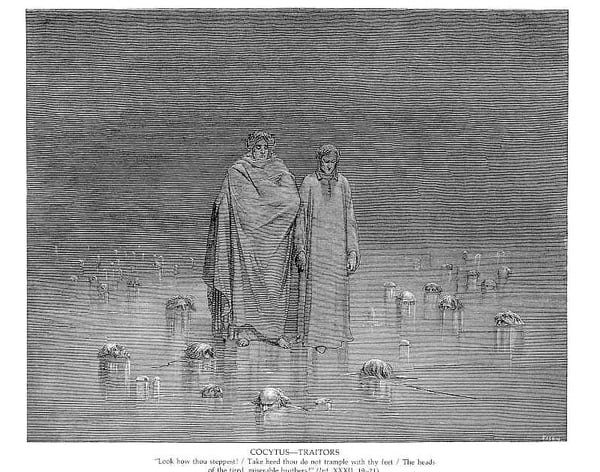
Gustave Doré’s Cocytus—Traitors stands as a masterful exemplar of Romantic illustration, and its significance lies in how it transforms a literary vision into a visceral, sublime experience. Executed for his 1861 edition of Dante Alighieri’s Inferno, this work depicts the ninth and final circle of Hell—a frozen lake where the souls of traitors are encased in ice, their bodies contorted in eternal agony. Doré’s treatment of this scene is a landmark of Romantic visual storytelling, merging technical virtuosity with profound emotional and psychological depth.
The Romantic Sublime and Horrific Grandeur
Romanticism prioritized intense emotion, the awe-inspiring power of nature, and the grotesque as a pathway to the sublime. Doré achieves all of this by emphasizing scale and contrast. The viewer looks out over an immense, cavernous landscape of jagged ice under a pitch-black sky, lit only by a chilling, otherworldly glow. In the foreground, the giant Antaeus (who in Dante’s text lowers Dante and Virgil into the abyss) is dwarfed by the sheer immensity of the frozen waste. Doré’s cross-hatching and chiaroscuro—hallmarks of his engraving technique—create a sense of infinite, crushing cold. The composition draws the eye downward into the darkness, mirroring Dante’s descent and forcing the viewer to confront the moral abyss of treason.
Illustration as Psychological Landscape
Unlike a mere diagram of Hell, Doré’s image functions as a psychological portrait of damnation. The traitors are not merely punished; they are absorbed into the ice, their bodies becoming part of the landscape. Some heads are tilted back, mouths open in frozen screams, while others are submerged completely, their forms only hinted at beneath the translucent surface. This dissolves the boundary between figure and environment, suggesting that betrayal corroces the soul’s very identity. The icy medium—both literal and metaphorical—renders the traitors isolated, immobile, and utterly alone. Doré’s Romantic sensibility ensures that the horror is not only physical but existential: the traitors have become monuments to their own sin, frozen in a state of perpetual self-reflection.
Significance within the Romantic Period and Doré’s Oeuvre
Doré’s illustration is significant for its fusion of precise naturalism and heightened drama. While the ice and rocks are rendered with geological accuracy, the emotional tenor is deliberately overwrought—a key Romantic strategy. The work also demonstrates Doré’s ability to translate dense literary allegory into accessible yet complex visual language, making him one of the most influential illustrators of the 19th century. Cocytus—Traitors specifically influenced later Romantic and Symbolist artists—as well as filmmakers and graphic novelists—with its stark, cinematic composition. Its enduring power lies in its quiet terror: no fire, no demons, just an endless, silent freeze. In this, Doré captures the Romantic conviction that the greatest horror is not punishment, but the total absence of warmth, light, and human connection.
Visivamente simili
20 opere con composizione e palette affini
The Inferno, Canto 32
Gustave Dore
Traitors--Bocca Degli Abati
Gustave Dore
The Inferno, Canto 32
Gustave Dore
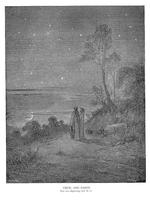
Virgil and Dante
Gustave Dore
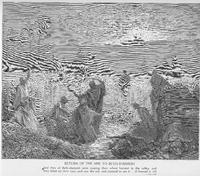
The Ark Is Returned to Beth shemesh
Gustave Dore
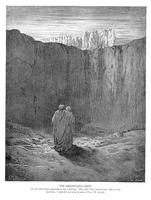
The Mountain's Foot
Gustave Dore
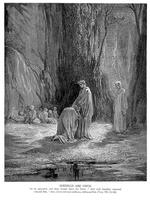
Sordello and Virgil
Gustave Dore
Ugolino and Archbishop Ruggieri
Gustave Dore
The bagged
Francisco Goya
The Punishment of the Simonists
Gustave Dore
Gideon Chooses 300 Soldiers
Gustave Dore
The Inferno, Canto 19
Gustave Dore
Israelite Women Mourn with Jephthah's Daughter
Gustave Dore
Pia
Gustave Dore
Farinata
Gustave Dore
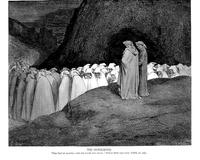
The Hypocrites
Gustave Dore
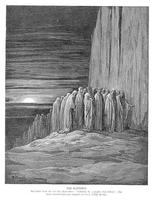
The Slothful
Gustave Dore
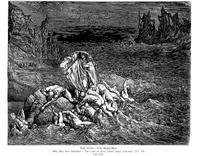
The Styx--The Irascible
Gustave Dore
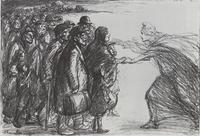
Les Refugies de la Meuse
Theophile Steinlen
Inferno Canto 4
Gustave Dore