
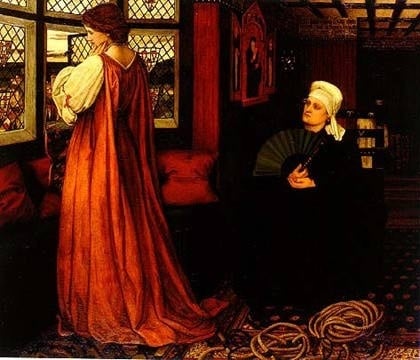
Análisis experto de Juliet and her nurse de John Roddam Spencer Stanhope
Estilo: Romanticism · Género: literary painting
Expert Analysis: "Juliet and her Nurse" by John Roddam Spencer Stanhope
This literary painting, executed in the Romantic style, captures a pivotal moment from Shakespeare’s Romeo and Juliet with profound emotional depth. Stanhope, while often associated with the later Pre-Raphaelite movement, here channels the core Romantic emphasis on intense feeling, individual drama, and the sublime power of human passion.
Significance within Romanticism:
- Emotional immediacy: The scene focuses on the private, psychological tension between Juliet and her nurse, rather than a grand public spectacle. This reflects the Romantic fascination with inner turmoil, secret love, and the conflict between social duty and personal desire.
- Narrative compression: Stanhope selects a moment ripe with anticipation—likely just before or after Romeo’s departure or the nurse’s delivery of news. Romantic literary painting prizes such charged instants, where the viewer is invited to imagine the before and after.
- Atmospheric color and light: Typical of Romanticism, the work likely employs a warm, dramatic palette—deep reds, golds, and shadowy interiors—to heighten the sense of intimacy and impending tragedy. The nurse’s protective, earthy presence contrasts with Juliet’s ethereal, yearning figure, embodying the Romantic dichotomy of the mundane versus the ideal.
Significance within literary painting:
- Faithful yet interpretative: As a literary painting, it not only illustrates Shakespeare but also interprets the subtext. The nurse’s body language (often a mixture of complicity and concern) and Juliet’s anxious posture reveal the psychological stakes—loyalty, secrecy, and the cost of forbidden love.
- Elevation of the domestic: Romantic literary painting often reimagines classical or high literary sources through a more intimate lens. Here, Stanhope dignifies a domestic, female-centered scene, placing the nurse—a secondary character—on equal visual footing with the heroine, thus expanding the narrative’s emotional range.
Conclusion:
Stanhope’s Juliet and her Nurse exemplifies Romanticism’s power to transform a familiar literary moment into a poignant study of human longing, trust, and foreboding. Its significance lies in how it melds Shakespeare’s timeless tragedy with the Romantic painter’s obsession with interior life, making the viewer feel the weight of every glance and gesture. The work stands as a testament to the era’s belief that art should stir the soul through story, symbol, and sentiment.
Visualmente similares
20 obras con composición y paleta relacionadas
Werl Altarpiece - St. Barbara
Robert Campin
The Birth of John the Baptist
Jan van Eyck
Two Legends of St. Nicholas
Gerard David

The Arnolfini Wedding. Portrait of Giovanni Arnolfini and his Wife Giovanna Cenami (The Arnolfini Marriage)
Jan van Eyck
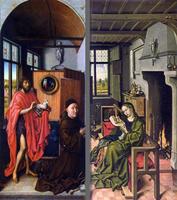
Werl Altarpiece
Robert Campin

Clara von Bork
Edward Burne-Jones
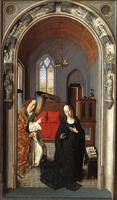
The Annunciation ((Polyptych of the Virgin, the wing)
Dirk Bouts
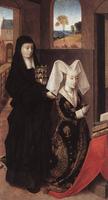
Isabella Of Portugal With St. Elizabeth
Petrus Christus

Thoughts of the Past
John Roddam Spencer Stanhope
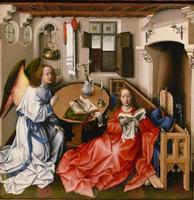
The Mérode Altarpiece - The Annunciation
Robert Campin
St. Eligius as a goldsmith showing a ring to the engaged couple
Petrus Christus
Scena Dell'ostello
Pieter Brueghel the Younger

Card Players
Lucas van Leyden
Albrecht of Brandenburg as St. Jerome in his study
Lucas Cranach the Elder

St. Jerome in his Study
Jan van Eyck
Adoration of the Magi: Whole Triptych
Hans Memling

The Magdalene Reading
Rogier van der Weyden
Card Players
Lucas van Leyden

The Flagellation of St Engracia
Bartolome Bermejo
The Annunciation
Robert Campin