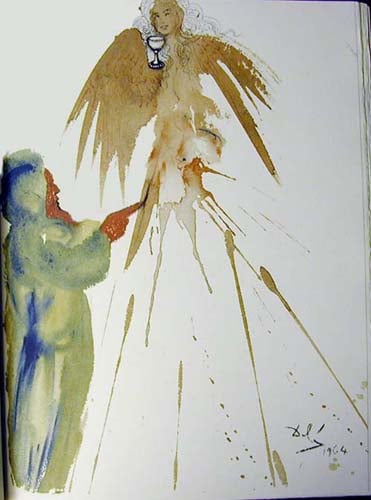
Oblatio munda
Details
Expertenanalyse zu Salvador Dalis Oblatio munda
Stil: Abstract Expressionism, Symbolism · Genre: religious painting
Expert Analysis: "Oblatio munda" (c. 1950s, Classic Period)
Salvador Dalí’s "Oblatio munda" (Latin for "pure offering") stands as a remarkable synthesis of two seemingly opposing forces: the gestural freedom of Abstract Expressionism and the dense iconographic tradition of religious painting, filtered through Dalí’s own idiosyncratic Symbolism. Created during his Classic Period (1941–1989)—a phase in which the artist increasingly turned toward spiritual, historical, and scientific themes—this work marks a pivotal moment where Dalí abandons his earlier Surrealist dreamscapes in favor of a more direct, yet deeply mystical, engagement with faith.
Formal Innovations: Abstract Expressionism Meets Sacred Imagery Dalí’s adoption of Abstract Expressionist techniques—broad, energetic brushstrokes, drips, and seemingly spontaneous marks—is unusual for an artist renowned for his hyper-realistic, "hand-painted dream photographs." Here, the canvas is dominated by a turbulent field of neutral earth tones, white, and deep browns, with patches of translucent colour that suggest both decay and illumination. The "abstract" quality does not negate figuration; rather, it dissolves the boundary between form and formlessness. Crucially, Dalí uses these expressive gestures to represent the invisible—the act of prayer, the unceasing flow of grace, or the chaos of the world being purified. The title "Pure Offering" implies a sacrificial gesture, and the physicality of the paint application itself becomes a metaphor for the artist’s own offering of self to the divine.
Symbolist Core: The Iconography of Redemption Despite its abstract tendencies, "Oblatio munda" retains clear Symbolist elements. Central to the composition is a faint, cruciform structure—an almost dissolved cross—that emerges from the painterly thicket. Dalí often fused the crucifixion with atomic or nuclear imagery during his Classic Period; here, the cross is not a rigid outline but a vortex of energy, suggesting both destruction and transformation. Small, almost calligraphic signs—a chalice, a wafer, a halo-like circular break in the pigment—anchor the work to Christian liturgy. The Latin title directly references the offertory of the Mass, where bread and wine are set apart for consecration. Dalí thus transmutes the physical act of painting into a Eucharistic act: the canvas receives the "pure offering" of his labour.
Significance within Dalí’s Oeuvre and the Period This work is significant for several reasons:
-
A Bridge between Movements: Dalí was notoriously skeptical of Abstract Expressionism, calling it "schizophrenic" and "accidental." Yet "Oblatio munda" demonstrates his ability to absorb its visual language for his own symbolic ends. It is a rare instance where Dalí’s rigorous technique meets the spontaneous, faith-driven energy of painters like Franz Kline or Barnett Newman—but always tethered to a theological narrative.
-
Classic Period Spirituality: After World War II and the atomic bomb, Dalí turned to Catholic mysticism (inspired by the writings of St. John of the Cross). "Oblatio munda" belongs to this mature phase, where he insisted that "the only difference between myself and a madman is that I am not mad" while pursuing a "nuclear mysticism." The work eschews his earlier shock tactics for a solemn, almost liturgical abstraction—a prayer in paint.
-
Genre Transcendence: As a religious painting in an Abstract Expressionist idiom, "Oblatio munda" challenges the mid-century dichotomy between spiritual abstraction (e.g., Rothko’s chapels) and representational devotion (e.g., Rouault). Dalí refuses to choose: the work is simultaneously a pure aesthetic object and a functional devotional image, echoing the medieval tradition of the imago mundi.
Conclusion: A Hidden Masterpiece of Modern Mysticism While Dalí is celebrated for The Persistence of Memory and Christ of Saint John of the Cross, "Oblatio munda" reveals a lesser-known but crucial facet of his genius: the ability to reconcile the most radical artistic experiments of his time with the deepest currents of Christian symbolism. It stands as a testament to the Classic Period’s central preoccupation—the search for unity between science, art, and the sacred—and demonstrates that even in abstraction, Dalí remained a consummate storyteller and iconographer. The work invites the viewer to see beyond its surface chaos and recognize a "pure offering" of faith, technique, and spiritual longing.
Visuell ähnlich
20 Werke mit ähnlicher Komposition und Farbpalette
Seduxisti me, Domine
Salvador Dali
Vox clamantis
Salvador Dali
Licet tributum dare Caesari?
Salvador Dali
Hircus caprarum super faciem terrae
Salvador Dali
Tertia die resurrexit
Salvador Dali
Mane, thecel, phares
Salvador Dali
Icon Painter
Vasyl Yermylov
Kolner Serie # 20
Maria Bozoky
Devant sa tente à Mamre
Maria Bozoky
Ecce virgo concipiet (Isaiah 7:14)
Salvador Dali
Mariae annunciato (Luke 1:26f)
Salvador Dali
Beati pauperes... Beati mites ... Beati (Psalms 1:1)
Salvador Dali
Cadaver in seoulchro Elisei (2 Kings 13:21)
Salvador Dali
Trulla caementarii in manu Domini (Amos 7:7)
Salvador Dali
Abraham, Abraham! (Genesis 22:2)
Salvador Dali
Moses with the Burning Bush
Marc Chagall
Iesus super mare ambulans (Matthew 14:26)
Salvador Dali
The sacrifice of Isaac
Marc Chagall
Study to "The Jacob's Dream"
Marc Chagall
De cruce depositio
Salvador Dali